
Before Crete (Κρήτη: Krētē) was, in fact, called Crete, it was referred to as Kaptara (its earliest known reference, c. 1800 BCE) in Syrian and Neo-Assyrian, Keftiu (Kftı͗w, c. 1480 BCE) in Ancient Egyptian, and Caphtor in the Bible.

“Crete” to Ancient Egyptians (And Potentially Even Minoans)
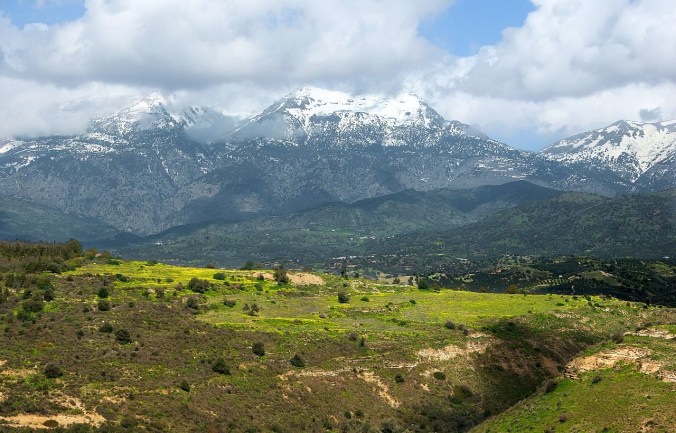
Many scholars deem Keftiu to be more similar to the Minoan name than “Minoan” ever was, which may be derived from the Greek word for “the nail of the earth” or “the peak of the mountain”. This phrase refers to the dominant peak of Crete (Mount Ida at 8,058 feet), which was a well-known landmark for seafarers. The Middle and Late Egyptian versions were as follows: Keft, Keftu, Kaftu, Kafta, Kefdet, Keftju.
However, it is important to note there’s been much debate over what Keftiu is truly referring to. While some scholars say Cyprus or Syria, the stone base of a statue during Amenhotep III’s reign states otherwise. Kftı͗w is in a list of Mediterranean ship stops to Cretan cities like Kydonia and Phaistos, which clearly points to the Aegean, not Anatolia.
“Crete” in Mycenaean Greek
Its initial Crete-adjacent iteration was found in Mycenaean Greek texts dating back to around 1,500 BCE. In Linear B, it was written as 𐀐𐀩𐀳 (ke-re-te) at first. Later on, it took on the names 𐀐𐀩𐀯𐀍 (ke-re-si-jo), Κρῆτες (Krētes), and Κρήσιος (Krēsios).
“Crete” in Ancient Greek
In Ancient Greek, Crete’s current name (Κρέτα (Kréta) to the ancient Doric Greeks) first appeared in The Odyssey. While its etymology isn’t entirely certain, there are two main propositions. The less likely notion between the two is that Crete could stem from a hypothetical Anatolian Luwian word kursatta (kursawar: island). However, there’s more of a consensus surrounding its Ancient Greek origins. Crete could very well stem from “κραταιή” (krataie̅), which means strong or stronghold, reflecting the fact that the island was the strongest thalassocracy (maritime empire) in the ancient world.
Two Greek Homonyms that Could Actually Be Related?
Interestingly, κριτικός (krētēkos), which is a homonym of Κρητικός (what you call a Cretan man), means “able to discern or be critical.” Though this is simply something I personally noticed, this could relay to their command over both rugged terrain and tumultuous sea, and the critical thinking involved in traversing both.
Another near-homonym could just be another interesting coincidence, but when it comes to Caphtor, that is very similar to the word for “hot” in Greek (kaftó: καυτό). Crete has a temperate Mediterranean climate, which means summers are hot and dry. I can even attest to the intense heat having stayed at my γιαγιά’s non-airconditioned house during many a summer.
I’d definitely take the above thoughts with a grain of salt because the closest Greek word to Keftiu is keftés (κεφτές), which means “meatball”. While κεφτέδες are a Greek delicacy, the two words are clearly not related. It’s just interesting to me that some foreign names for Crete actually hold relevant meanings.
Even More Names!
From Kaptara to Krētē, the ‘k’ sound has (mostly) remained since its very first known iteration. However, what has been mentioned isn’t all-inclusive. In Latin, Crete is Creta, whereas the original Arabic name was Iqrīṭiš (اقريطش) and then changed to Χάνδαξ (Chandax).
Candia, derived from the French Candie, was used in Latin, Italian, and Venetian. In Ottoman Turkish under Ottoman rule, Crete was called Girit (كريد: precious stone), which brings up another uncanny coincidence. My μαμά’s Cretan maiden name means precious stone, which I won’t mention here for privacy reasons. The “-akis” suffix was added later on, which means “small”, changing the name meaning to pebble. While that’s a point of pride during modern times, that was added to Cretan surnames during the Turkish occupation to demean Cretans.
Sources
- Caphtor/Keftiu: A New Investigation by John Strange
- The Aegean Bronze Age by Oliver Dickinson
Discover more from Minoan Magissa
Subscribe to get the latest posts sent to your email.
 Minoan Magissa
This reminds me of Shakespeare’s, “What’s in a name? That which we call a rose, by any other word would smell as sweet.”
LikeLiked by 1 person
Very interesting post! I’m a student of ‘Minoan’ Crete so it’s good to see this blog.
LikeLiked by 1 person
Thank you! I’m glad you came across my blog then. 😊
LikeLiked by 1 person
highly informative! thanks for the info on Crete – or should i say ‘Krete’ 🙂
LikeLike