Communing with My Ancestors at Knossos (a poem with photos)

a piece about my unforgettable visit to the Palace of Knossos that connected me to my ancestors in a way nothing else has…
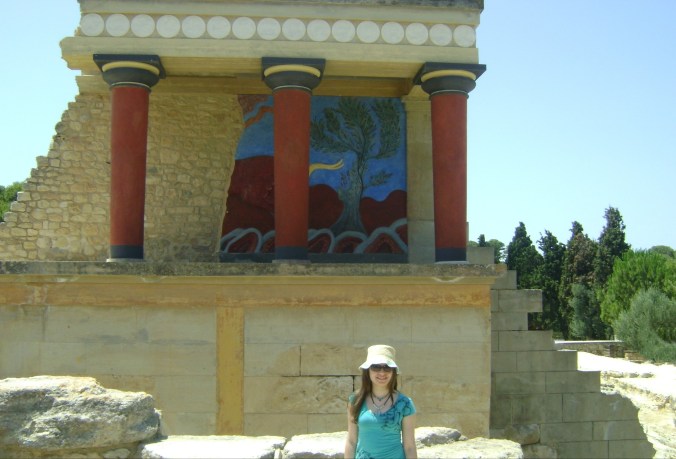
Me by the Restored North Entrance with the Charging Bull fresco
me by the Restored North Entrance with the Charging Bull Fresco

Mid-July sun scalds skin and ancient sites indiscriminately
and illuminates the same steps my ancestors took thousands of years ago.
The trickles of sweat down my brow are overshadowed by
the tingle up and down my spine as I approach
pithoi1 that once contained oil from olive trees that may still live to this day,2
vibrant frescoes that still echo the artistry of masterful Minoans
despite destruction by both nature’s and occupiers’ hands
and some questionable reconstructions,
labyrinthine paths that, along with midday heat, further dizzy me.

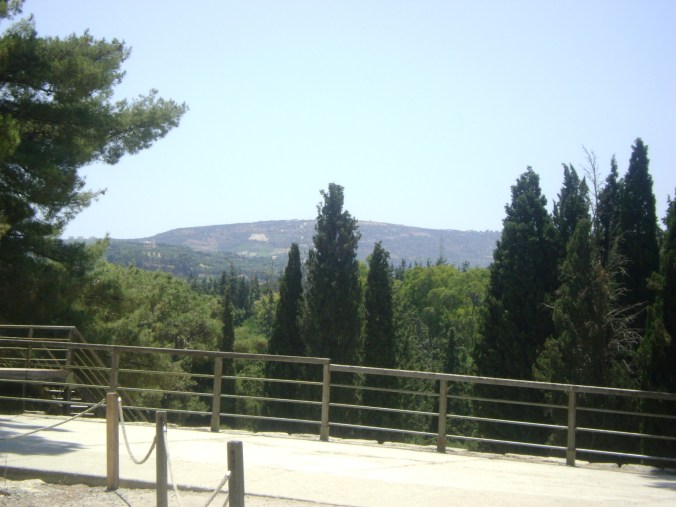
Knossos stonework, paths, and stairs
the view from Knossos

Mouth dry but mind bedazzled by
Mount Juktas (Γιούχτας)3 nearby
and Kephala Hill (Κεφάλα)
upon which Knossos (Κνωσσός) was built
that have seen it all since the dawn of their time,
stone pines and cypress that envelop the sacred ruins
and perfume the air with an earthy resinous aroma
that graced festivals and rituals millennia ago.

The view from Knossos
Knossos souvenir shop

Finding solace in the shade of a souvenir shop
with the words “Knossos Antiquities” on the side
and shrubbery along the top,
I immediately decide on a golden figurine
of the Snake Goddess with an owl atop her head,
not a cat that Arthur Evans and Halvor Bagge proposed
and transposed upon her crown.
As the sun shines just right,
I then catch a glimpse of a mini Lily Prince
with a similar golden finish
and know then and there: I just have to have it!
Having promised my friends overseas
that I’d send them post cards,
I also select several that show Knossos
in its most magnificent light.

Snake Goddess and Lily Prince figurines from a Knossos souvenir shop
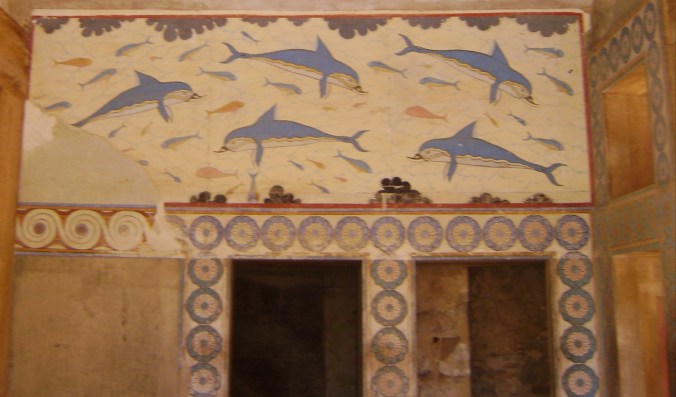
The Dolphin Fresco

Upon returning to grandma’s (γιαγιά) house,
and after being well-fed, of course,
a satisfying exhaustion takes over my body
and I fall into a deep sleep,
charging bulls, dolphins, and griffins infiltrating my dreams.
The Lily Priest-King and The Snake Goddess themselves
observe me from afar with knowing smiles but grave eyes
as it starts raining rosettes.
A sudden tidal wave hits the Palace,
and a chilling darkness overcomes me.
I wake in a cold sweat in the same blackness
and fear I haven’t awakened at all4

《Κόπηκε το ρεύμα,5》my γιαγιά blurts out.

***

I may have left, but the magic of Knossos
will never leave my heart and psyche,
even if I never set foot there ever again
6.


*More photos from my trip can be viewed here.
Please pardon the blurriness in some – these were all taken with a relatively cheap digital camera back in 2011…

Rosette divider
  1. ancient storage vessels ↩︎
  2. Gra Elia, while not at Knossos, is an ancient olive tree nearby that’s situated in the village of Vorizia, Heraklion. ↩︎
  3. a mountain located several kilometers away from Knossos that was a significant religious site for the Minoans ↩︎
  4. This actually happened! I sincerely thought I died. ↩︎
  5. “The power went out.” ↩︎
  6. I dream of being healed enough from generational trauma that I can return to my homeland someday. ↩︎

The Flowery Childhood of The Lily Prince (a poem) 𓆸


a Minoan-inspired poetic story about how The Lily Prince got his name


Soon after he took his initial steps,
his heart was drawn to the coast at sunset
bedecked with rosen cumulus clouds.
The seagulls’1 elegiac yeows
set to the Aegean’s sonorous symphony—
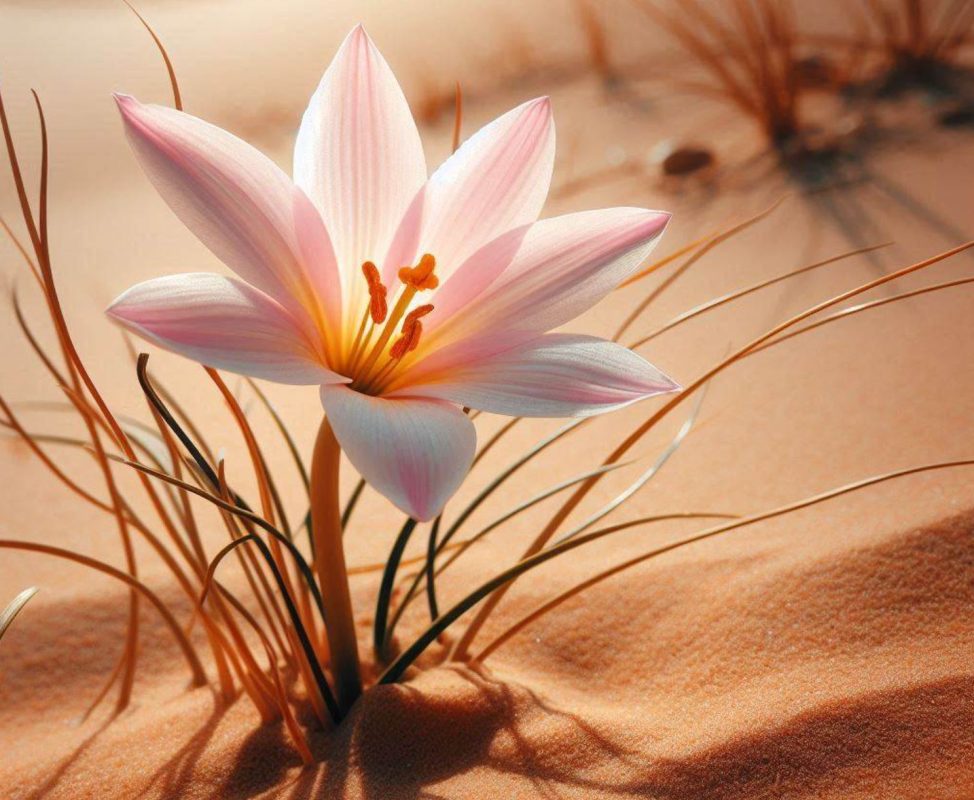
all served as an invitation from the sand lilies2.

Prince of the Lilies Reconstruction from Original Fragments


So, the young wide-eyed prince wandered off
every opportune moment he got
to inhale the warm salted air
sweetened by the flowers’ subtle flair.

But it wasn’t long before his mother caught up
and urged him to return with her to the palace at once.
And he would oblige, for he was the Wanax’s3 son,
but not before he picked her the most vibrant one.

Cretan sand lily from Wikimedia Commons


P.S. You’ll be seeing quite a bit of Minoan-inspired poems from me this month because it’s National Poetry Month/NaPoWriMo. 😀

  1. Seabirds of the genus Larus were likely present in ancient Crete. ↩︎
  2. Also known as a sea daffodil or sea lily (Pancratium maritimum), the sand lily is native to Crete and has been around since prehistoric times, with the Minoans depicting it in their art. ↩︎
  3. “king” in Mycenaean Greek (pronounced as wa-na-ka in Linear B). While not directly associated with Minoan rulers, there is evidence of kings in Minoan Crete, but there is no known word for them. ↩︎

Minoan Mantinades / Μινωικές Μαντινάδες (folk poems by a Cretan-American poet)

Mantinades (derived from the Venetian matinada: morning song) are Cretan folk poems/songs that consist of rhyming couplets at 15 syllables per line (called dekapentasyllabos) in a Cretan Greek dialect (mine’s a little rusty; I made do, though). Usually, one couplet can stand alone and they are improvised. But often being antiphonal in nature, a verse elicits a response, so the verses can be many. This poetic form initially appeared in Crete during the 15th century, which coincided with the period of Venetian rule over the island.

Seeing as the Greek and English languages differ a great deal, my translations will be 10 syllables per line and the meanings may vary somewhat to maintain a rhyme scheme.

During my summers in Crete, mantinades were recited at gatherings accompanied by the Cretan lyra and laouto or in everyday conversation. My γιαγιά (grandma) would often tell me a few that her mother passed down to her and so forth. She’d say them so many times that I remember some by heart. Here’s one of them that she’d recite when she’d wake up at dawn to take care of her animals and crops and was especially groggy:

Νυστάζω και κλονήζω και ποίος θα πάει στο μύλο;
《Άσου ρε κυρία και εγώ θα πάω στο μήλο!》

I’m exhausted. Who will go to the mill?
“Stay put. I’ll go to th’orchard by the hill!”

Funnily enough, it took me until now to realize the true meaning behind it! I wondered why she’d use the exact same word for the “rhyme”, but she didn’t. There are two kinds of “milo” spelled slightly differently: a mill and an apple orchard. So basically, the person reciting this doesn’t really want to go to work but knows they have to. The other person who offers to help conveniently mishears, which further reiterates that no one is going to do their appointed job but themselves.

Minoan Woman Fresco Fragment by Wolfgang Sauber
Minoan Woman Fresco Fragment. Photo Credit: Wolfgang Sauber

But you’re probably here for the Minoan-inspired poems! Here’s a modern-meets-ancient spin on classic mandinades…

Original Greek Version:

Ήντανε τούτο που ερχόντας απ’ μέρος μακρινό,
που ξανοίγω με τα Θολωμένα μάτια μου τα δυό;

Θωρώ ματιά κρυστάλλινα σαν ηλιόλουστα νερά
και ρούχα μπαλωμένα με κουρασμένα πρόσωπα.

Transliteration:

Íntane touto pou erchóntas ap’ méros makrinó,
pou ksanígo me ta tholoména mátia mou ta dyó?

Thoró matiá krystállina san iliólousta nerá
kai roúha baloména me kourasména prósopa.

English Translation:

What is this from such faraway isles
that I observe with these eyes beguiled?

I see eyes crystalline like sunlit seas
with weary faces and clothes frayed at seams.

*about a rich isolated Minoan girl seeing outsiders for the first time. Most Minoans being dark-haired with dark eyes and olive skin, seeing pale blue eyes would probably be quite the shock as well as clothing that isn’t as vibrant and elaborate as theirs.

Original Greek Version:

Φορώ τη καλύτερη μου φούστα με μπλέ φυλαχτό.
Απόψε Η Θεά θα μας φέρει άνεμο θερμό.

Transliteration:

Foró tin kalýteri mou foústa me blé fylahtó.
Apópse I Theá tha mas férei ánemo thermó.

English Translation:

I wear my best skirt with my blue pendant.
Tonight, The Goddess will bring us warm wind.

*about a Minoan woman who dresses her best to attend the spring festival in order to ask The Goddess for the warm winds that will bring everything to life. The Minoans took pride in their sense of style in general, but they especially had to bedeck themselves during festivals and other important events out of respect.

Original Greek Version:

Ξέφυγα κρυφά για ταυροκαθάψια το πρωί.
Ευτυχώς η μαμά και γιαγιά δεν πήραν χαμπάρι!

Transliteration:

Kséfyga kryfá gia tavrokathápsia to proí.
Eftychós i mamá kai yiayiá den píran habári!

English Translation:

I snuck away at dawn for bull-leaping.
Good thing mom and grandma were still sleeping!

*about a Minoan girl who is secretly practicing bull-leaping against her family’s wishes. Inspired by the character Martis in In the Shadow of The Bull by Eleanor Kuhns. However, it’s important to note that sports were not limited to men only in Minoan society. Still, families presumably wished for their children to survive into adulthood and marry. Bull-leaping wasn’t exactly a safe sport…

Original Greek Version:

Αυτό το κουζουλό κοπέλι δεν κατέει πράγμα.
Πάω σε κάθε απόδοση. Θεά, δως μου θαύμα!

Transliteration:

Aftó to ómorfo kopéli den katéei prágma.
Páo se káthe apódosi. Theá, dos mou thávma!

English Translation:

This silly guy, the truth he doesn’t see.
I attend all his gigs. Goddess, guide me!

*about a Minoan girl who is in love with a silly, clueless boy. He’s somehow still oblivious even though she’s been at every single bull-leaping performance he’s in. I’d imagine matters of the heart would be petitioned to The Goddess. These pieces really aren’t meant to be entirely historically accurate.