A Union Blessed by The Minoan Snake Goddess (a poem)

a mythological poetic story inspired by the Minoan religion and their sacred rites

Black snakes coil down The Priestess’ arms,
and like fine silk in steady wind, slither upon
a stone pillar etched in Linear A,
where they entwine like DNA
alongside offerings of bull’s blood, honey, and olive oil.
All falls silent, between sky and soil.


It is then that The Priestess and her procession make a plea
to The Snake Goddess:

Hail, A-ta-no-dju-wa-ja,
Goddess of Fertility!
Bless this union as sacred as sea:
one a celebrated bull-leaper,
the other an adept healer.

May she, the contender of bulls, continue to leap unscathed.
May he, the alchemist of medicine, continue to restore the sick’s fate.
As souls united,
may their love remain requited.
May their children lead bountiful lives,
and may the lineage continue to thrive.

Both bride and groom reach their arms out towards the dual snakes,
and, as if by the Goddess’ decree, they reanimate
and start to coil up their adjacent arms and conjoin at the tails.
The blessing of Atana Potinija is now upon them!
The union shall, through devastation and elation, prevail!

a fresco of a Minoan bride and a groom. It is customary for women to be depicted as pale 
and men to be depicted as tan in Minoan frescoes.
a Minoan-fresco-inspired illustration of a Minoan bride and groom by Luisa Donber. It is customary for women to be depicted as pale and men to be depicted as tan in Minoan frescoes.

Crete: The Cradle of Minoan Culture by Len Kagami

This article is very detailed and full of stunning photos. I highly recommend reading it and following Len’s blog! 🙂

Ariadne: The Formidable Princess of Ancient Crete

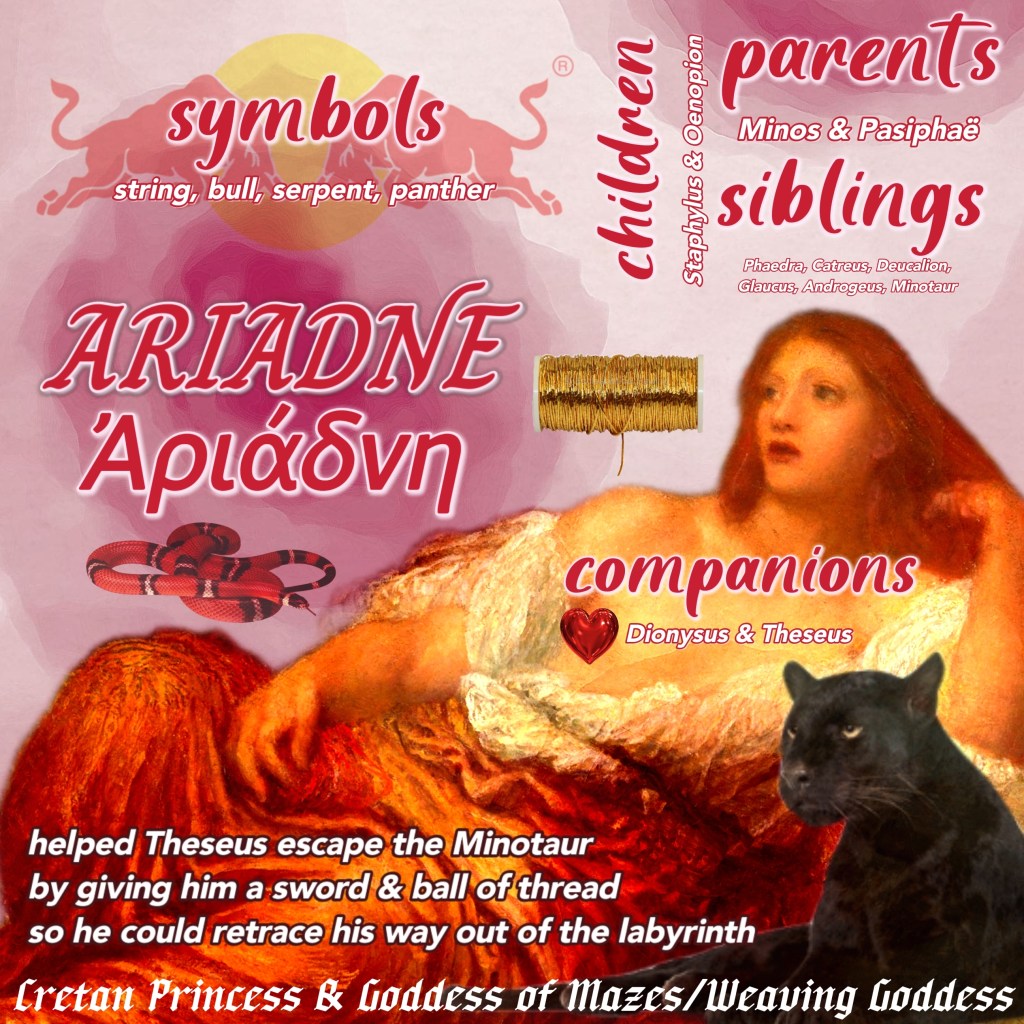
Ariadne (Greek: Ἀριάδνη) was a Cretan princess and the daughter of King Minos (the mythic king that the Minoans were named after) and Pasiphae (a sorceress and daughter of Helios). Upon her death, she was regarded as a goddess of labyrinths and paths.

a painting of Ariadne in a reclining position with two leopards nearby. She is by a harbor.

Ariadne by John William Waterhouse (1898)

There are several versions of Ariadne’s myth, but she is best known for overseeing the labyrinth where sacrifices were made. Putting an end to these atrocities once and for all, she ended up assisting Theseus in his escape from the Minotaur (a half-bull, half-man creature) with a ball of thread, only to be abandoned by him at Naxos. Exhausted and heartbroken, she fell asleep at the island’s shore. Dionysus (god of wine and festivity) happened to see her, and it was love at first sight. They later married, and as a sign of his devotion, Dionysus tossed Ariadne’s bejeweled crown into the heavens, creating the Corona Borealis1. Her goddess status came after she died when her grief-stricken husband traveled to the Underworld and brought her back to life so they could be together forevermore.

Bacchus (Dionysus) and Ariadne by Giovanni Antonio Pellegrini (1720)

Bacchus (Dionysus) and Ariadne by Giovanni Antonio Pellegrini (1720)

While Ariadne is prominent in Greek mythology, linguist Robert S. P. Beekes and archaeologist Stylianos Alexiou have theorized that she had a pre-Hellenistic origin. The main reason is due to her name including “dn” (δν), which is particularly rare in Indo-European languages. Therefore, that points to her name stemming from Minoan loanwords2. Furthermore, Greek lexicographers have claimed that Ariadne is derived from the ancient Cretan dialectical elements: “ari” (ἀρι: most) and “adnós” (ἀδνός: holy), so The “Most Holy” One3.

Yet another aspect to Ariadne is that of a Minoan fertility goddess. Could it be that Ariadne was the Minoan’s mother goddess repurposed/re-imagined by the Greeks?

Some more information about her is included in the infographic I created below:

  1. Hall, James (2018). Dictionary of Subjects and Symbols in Art ↩︎
  2. Beekes, Robert (2010). Etymological Dictionary of Greek: Volume I ↩︎
  3. Hanks, Patrick; Hodges, Flavia (1997). A Concise Dictionary of First Names ↩︎