Our Goddess has one snake in each of her hands. We worship her with devotion each day.
One little owl sits on her crown. Life and death, she commands the two.
Note: In Sir Arthur Evans’ controversial rendition of the Minoan Snake Goddess, he placed a cat atop her crown that he found in one of his excavations. In a lot of Cretan renditions, there’s a little owl instead. Some scholars have posited that this Goddess is the precursor to the Greek goddess of wisdom & warfare (Athena); therefore, the owl addition makes more sense (they are a primary symbol of hers after all).
Η συγκομιδή ελιών και σταφυλιών ξεκίνησε! Kόκκινο χρώμα από τα δέντρα εμφανίζεται.
Η καλοκαιρινές ακτίνες του Ήλιου δροσίζουν. Στο πολύχρωμο τοπίο, oι δρόμοι ησυχάζουν.
Transliteration
I synkomidí elión kai stafylión xekínise! Kókkino chróma apó ta déntra emfanízetai!
I kalokairinés aktínes tou Íliou drosízoun. Sto polýhromo topío, oi drómoi isyházoun.
English Version
The olive and grape harvest has arrived! Auburn hues of oaks and planes come alive!
Summer sun softens, gives way to brisk days. Bustling streets halt in the changing landscape.
Literal Translation (sans proper syllable count)
The harvest of the olives and grapes has commenced! Red color from the trees appears!
The summer rays of the Sun are cooling. In the colorful landscape, the streets calm down.
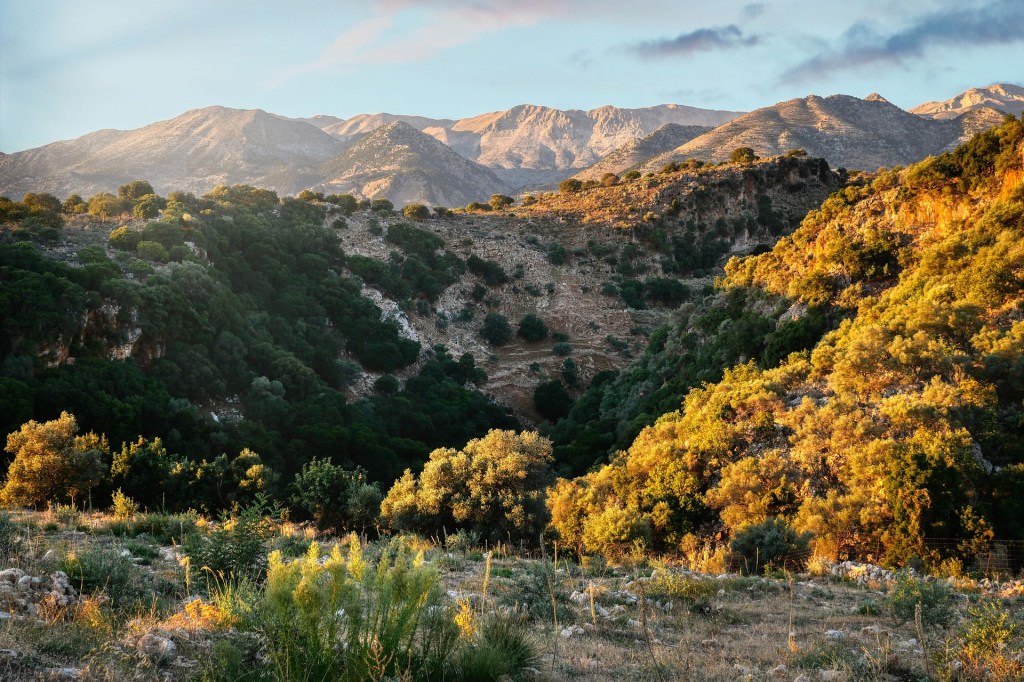
Note: While there’s a lack of records, modern trends of Cretan weather can inform the distant past. Autumn was and is a time for harvesting the island’s greatest commodities: olives and grapes. Wine was also made at this time. As the plane (platanos) and oak trees took on striking brownish-red and golden hues (but the deep green of cypress and olive trees remained), the Minoans, like present-day Cretans, prepared for the winter ahead. The seasonal shift definitely brought much reprieve on an island known for its summers of harsh heat and VERY dismal rain (if any).
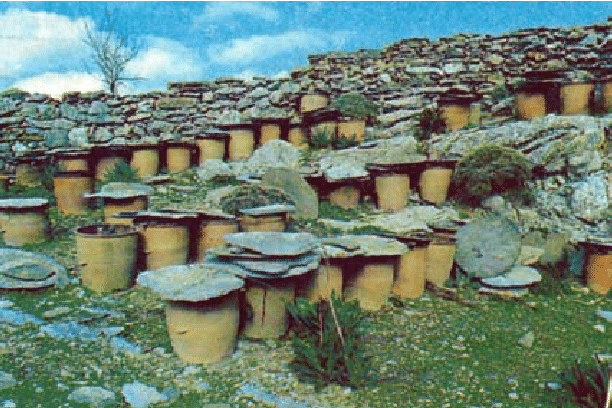
Beekeeping equipment, beehive fragments, and depictions of beehives that date all the way back to 1,700 BCE are amongst various archaeological findings on the island of Crete and Thera. From The Malia Pendant that depicts two conjoined bees to remnants of honey offerings to their deities, bees (and the honey they produced) were integral symbols to the Minoans.
Bees in Minoan Art
With how intrinsically connected the Minoans were to nature, it’s no surprise that bees and honeycombs were a recurrent motif in their frescoes, pottery, seals, and more.
The Bees of Malia
While archeologist Dr. Georgios Mavrofridis and some of his colleagues posited that The Malia Pendant was modeled after the mammoth wasp (Megascolia maculate), The Malia Pendant (Χρυσό κόσμημα των Μαλίων) and “The Bees of Malia” are used interchangeably. At first glance, the impression that these may be wasps instead makes sense, if it wasn’t for the Minoan’s tendency to distort, and in most cases exaggerate, the forms of creatures and humans alike in their art. Realism just wasn’t of primary focus. This embellished art style was also evident in Egyptian art, which directly inspired them. For instance, the elongated thorax and abdomen bees were often depicted with at that time emphasized fertility. Furthermore, The Malia Pendant showcased the production cycle of honey, and thus, the inescapable cycle of life and death.
Miniature Frieze from Akrotiri
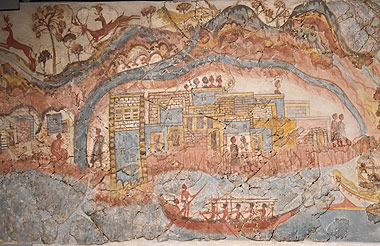
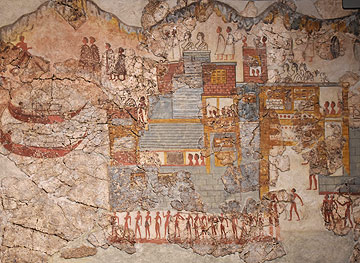
A potential apiary (a place where bees are kept) is depicted in the structure painted on the south wall of the Miniature Frieze from the West House at Akrotiri, Thera. Covering the slope of a hill, it comprises dual vertical blue bands on its western edge as well as four horizontal blue bands, five rows of black triangles with circular openings at their base alternating with the aforementioned bands. In addition to an apiary, this has been deemed a shipshed, storage area, and more.
However, there are several uncanny details that lean towards the apiary interpretation. For instance, the triangular aspects likely depict the fixed-comb beehives that are still used in Greece to this day. Moreover, the path that goes from the apiary and joins the settlement with the three-part building at the hill’s zenith may signify organized beekeeping. The trapezoid-shaped expanse of blue to the east possibly portrays a pond (a water source being another vital aspect of beekeeping). While theoretical, researcher Irini Papageorgiou believes the scope of the area encompassed by the installation and the prominence of beekeeping products (indicated by both chemical analysis and Linear B tablets references) do, in fact, point to an apiary.
Honey: Ambrosia of the Minoans
Honey was utilized in numerous areas of Minoan life, making it almost if not just as valuable as olive oil. With how ubiquitous of a commodity it was, this liquid gold had multifaceted symbolism to match.
Honey in Minoan Religion
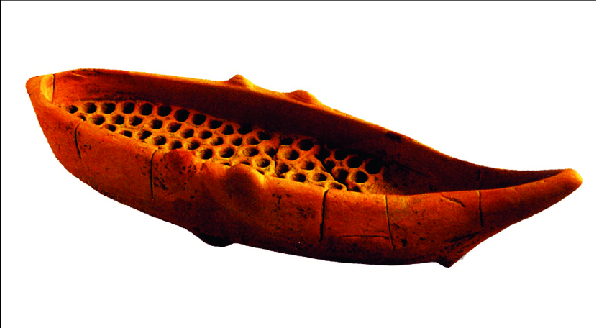
Based on archive tablets found at Knossos, it was noted that honey offerings were made to the pre-Hellenic goddess based out of Crete, Eileithyia (goddess of childbirth and midwifery). More specifically, the kernos or offering table in the temple at Malia was used to offer grains and honey to her. In general, the regenerative aspects of bees were a key symbolic attribute of a Minoan goddess.
Honeycomb imagery was also prevalent in various tombs, symbolizing the renewal to be found in the afterlife—renewal in the sense of change in form, not necessarily size (i.e. bees start as an egg, then larva, followed by pupa before fully grown).
Bees’ tendency to swarm and even dance in synchrony (and the fact that they congregate in hives) serves as a symbol of community and oneness.
And while more prominent in Ancient Greece, bees were generally regarded as divine messengers that imparted wisdom and eloquence to mortals when imbibed.
Honey in Economy, Trade, & Food
In addition to Minoan spirituality, honey was crucial to the Minoan economy and trade. Not only was it their primary source of sweetener, but it also provided them with a versatile food source with substantial nutritional value. Honey was a highly coveted additive of alcoholic beverages like mulled wine as well.
Honey in Skincare & Medicine
Honey was used as a skincare product and ointment across multiple ancient civilizations throughout West Asia and the Mediterranean, especially during The Bronze Age. Honey, often mixed with olive oil, was and is still used to hydrate, soothe, and exfoliate skin, leading to a more youthful complexion. Due to its anti-inflammatory and antiseptic properties, honey was applied to wounds for enhanced healing and to prevent infections.
Needless to say, honey was an elixir of life and longevity to countless civilizations, including the Minoan civilization.
Sources
A Re-Examination of the Malia Insect Pendant. American Journal of Archaeology: LaFleur, et al.
Minoans: Life in Bronze Age Crete by Rodney Castleden
Natural History of a Bronze Age Jewel Found in Crete: The Malia Pendant. The Antiquaries Journal: Georgios Mavrofridis, et al.





 Minoan Magissa