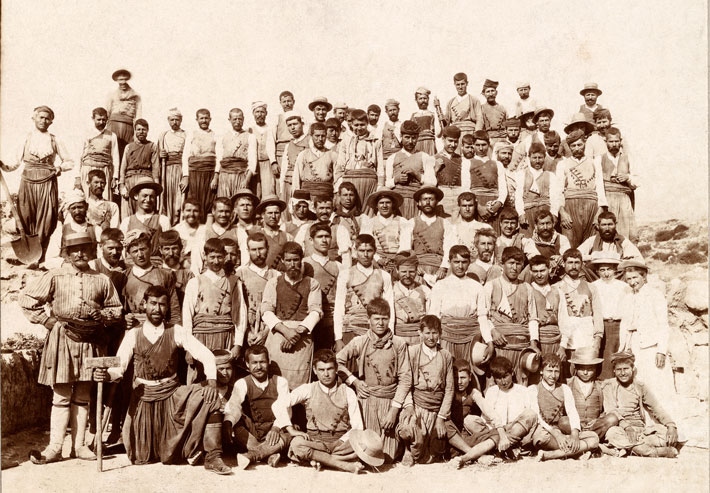
”I know a place where there are a lot of old things,” a peasant named George Perakis told the schoolmaster of the small village of Vasiliki, on the island of Crete, in the spring of 1901. Aware of a visiting American archaeologist’s anxious search to find a site of her own to excavate, the schoolmaster arranged for Perakis and his brother Nicholas to take Harriet Boyd and her colleague Blanche Wheeler to Gournia, four miles northwest of the village. Over several hours on May 19 Boyd collected a few potsherds and located the tops of several ancient walls, enough to convince her it was worth sending a team of workmen to the site the next morning. When she arrived at Gournia on the afternoon of the 20th, Boyd was astonished to see the men holding a bronze spear and sickle and numerous fragments of stone and pottery vessels, and clearing the threshold of a house and a well-paved road complete with a clay gutter. […]
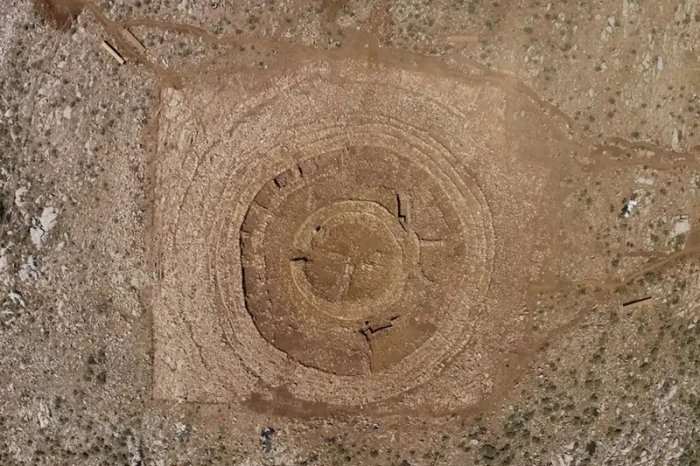
In June 2024, on Papoura Hill in Kastelli, Heraklion, Crete, an ancient monument was discovered that has both mystified archaeologists and offset the plans for a new airport. As with so many discoveries related to Minoan civilization, the purpose of this expansize maze-like structure is unknown.
However, here is what’s presently known: 🔸 It stems from the Protopalatial period (2000-1700 BCE – based on the style of pottery fragments found nearby). 🔸 It was built utilizing eight 1.4-meter-thick stone rings. 🔸 It spans 157 feet in diameter.
Surprisingly, parts of it are still well-preserved.
An aerial view of the circular structure. Credit: The Greek Ministry of Culture
Archaeologist Speculations: Tombs or Area of Worship?
According to The Greek Ministry of Culture, some of its features are notably similar to Minoan tombs and Hellenic mounds due to the intricate, circular stone-ring arrangement. What’s undermining this specific speculation is the vast number of ancient animal bones that have been uncovered. That finding, along with its location (an area of elevation), potentially points to a monument with a ritualistic purpose (offerings, sacrifices, feasts, etc.).
While these speculations seem sound, the construction plan itself did not share many similarities to other Cretan buildings of the same time period. Instead, it more closely resembled constructions from West Asia in the brink of the Bronze Age (i.e. the elliptical Middle Minoan building of Hamaizius and a circular proto-Hellenic cyclopean building of Tiryns).
Prioritizing the Protection of Ancient Sites
In addition to this labyrinthine structure, excavations have unearthed over 30 other archaeological sites throughout the area. A new airport has already been in-progress, but now that such amazing archaeological findings have been unveiled, a balance between modernization and maintaining cultural heritage must be maintained. In fact, when discussed, it was concluded that the latter is to be continually prioritized.
In general, The Greek Ministry of Culture is devoted to protecting ancient sites from modern development to safeguard the continuation of research and the conservation of history. This recent discovery, among dozens of others, gives deeper insight into a rich culture that still mystifies researchers to this day.
Sources
Smithsonian Magazine: Discovery of 4,000-Year-Old Structure in Greece Stumps Archaeologists Live Science: Mysterious 4,000-year-old ‘Palace’ with Maze-like Walls Found on Greek Island of Crete Hellenic Republic Ministry of Culture: ΥΠΠΟ: Εύρημα μοναδικό για τη μινωϊκή αρχαιολογία

 Minoan Magissa