
A Bull-Leaper’s Desire
Original Greek Version
Ο πιο δυνατός και γρήγορος ταύρος δεν με τρομάζει
αλλά κρατώ την πνοή μου όταν αυτός κοιτάζει.
Περνά συχνά να με βλέπει στην ταυροκαθάψια.
Το ενδιαφέρον του παίζει πολύ σημασία!
《Αγρίμι》 με φωνάζουν όλοι στο ντουνιά.
Λένε 《άφησε τούτο το σκοπό για να βρείς άντρα!》
Αλλά εγώ πιστεύω στο βάθος της καρδιάς μου,
θα βρω αγάπη χωρίς να σβήσω τα όνειρα μου.
English Transliteration
O pio dynatós kai grígoros távros den me tromázei
allá krató tin pnoí mou ótan aftós koitázei.
Perná sychná na me vlépei stin tavrokathápsia.
To endiaféron tou paízei polý simasía!
《Agrími》 me fonázoun óloi sto ntouniá.
Léne 《áfise toúto to skopó gia na vreís ántra!》
Allá egó pistévo sto váthos tis kardiás mou,
tha vro agápi chorís na svíso ta óneira mou.
English Translation
The strongest, swiftest bull doesn’t scare me,
but I hold my breath when he looks at me.
He comes by often to watch me bull-leap.
His interest makes my heart skip a beat.
“Wild one,” most of the villagefolk call me.
They say, “Quit this gig so you can marry!”
But I believe, deep in my heart of hearts,
I’ll find love without snuffing out my spark.

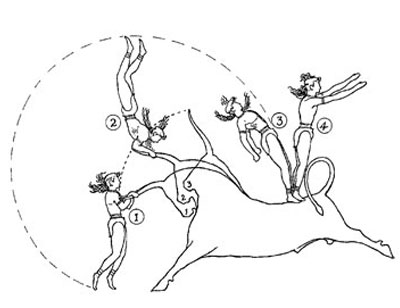
Note: This Cretan folk poem is about a Minoan bull-leaper who is seemingly fearless when it comes to bulls charging at her, but gets nervous the moment a romantic prospect looks her way. While Minoan society had egalitarian aspects (the fact that both men and women could be bull-leapers, for instance), there were still patriarchal elements and young women were expected to get married and start a family, as well as take on the family business. This starry-eyed bull-leaperess, however, plans on having both her love of bull-leaping and the love of her life someday. She refuses to give up one for the other!

 Minoan Magissa