Minoan Mantinada of the Month / Μινωική Μαντινάδα του Μήνα #6: Minoan Winter

Original Greek Version

Άσπρα σαν τα σύννεφα ειν’τα βουνά εκιά πέρα.
Βροχή και καταβατικοί άνεμοι κάθε μέρα!

Δόξα την Θεά που η συγκομιδή ήταν άφθονη,
η ζεστασιά στα παλάτια και σπίτια μας μπόλικη.

Transliteration

Áspra san ta sýnnefa ein’ta vouná ekiá péra.
Vrohí kai katavatikoí ánemoi káthe méra!

Dóxa tin Theá pou i synkomidí ítan áfthoni,
i zestasiá sta palátia kai spítia mas bóliki.

English Version

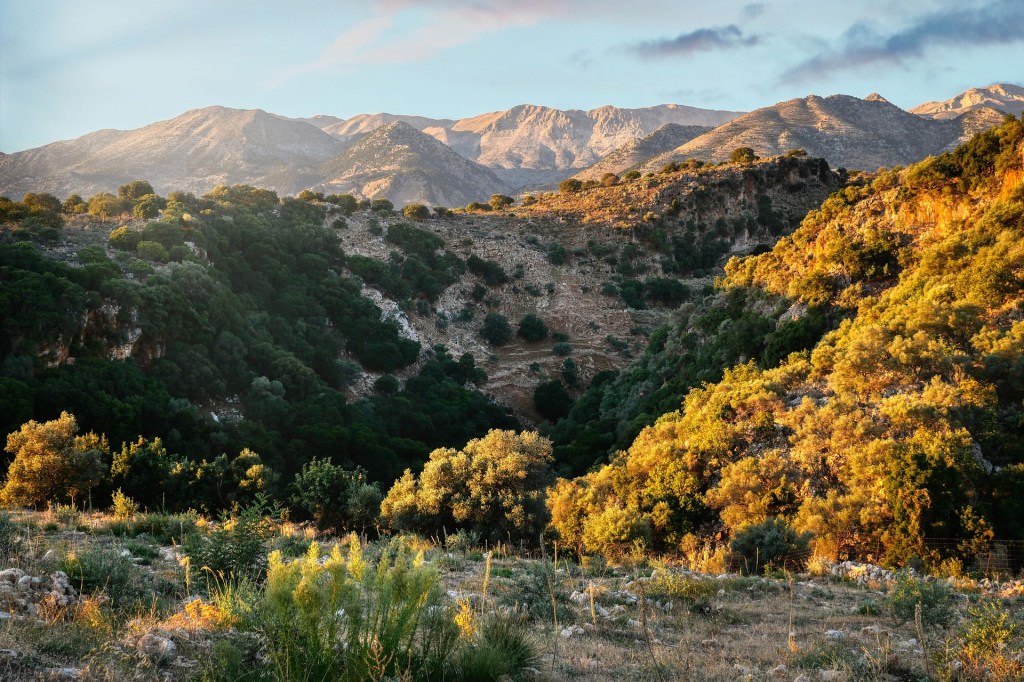
The mountains in the distance, white like clouds.
Rain and katabatic winds all around!

Thank Goddess the harvest was bountiful!
The warmth in our palaces, plentiful.

Mount Ida during winter

Note: Similar to Modern Crete, Ancient Crete had short, mild winters (though winters on the the north end were a little harsher). To keep warm, they utilized centralized heating systems in their palaces and elite homes and implemented bioclimatic architectural designs. Besides that, simple fires, heavier clothing, and communal living spaces were commonplace. Katabatic winds are winds that blow down a slope, which are caused by gravity pulling dense, cold air downhill.
Minoan Mantinada of the Month / Μινωική Μαντινάδα του Μήνα #4: Minoan Autumn

Original Greek Version

Η συγκομιδή ελιών και σταφυλιών ξεκίνησε!
Kόκκινο χρώμα από τα δέντρα εμφανίζεται.

Η καλοκαιρινές ακτίνες του Ήλιου δροσίζουν.
Στο πολύχρωμο τοπίο, oι δρόμοι ησυχάζουν.

Transliteration

I synkomidí elión kai stafylión xekínise!
Kókkino chróma apó ta déntra emfanízetai!

I kalokairinés aktínes tou Íliou drosízoun.
Sto polýhromo topío, oi drómoi isyházoun.

English Version

The olive and grape harvest has arrived!
Auburn hues of oaks and planes come alive!

Summer sun softens, gives way to brisk days.
Bustling streets halt in the changing landscape.

Literal Translation (sans proper syllable count)

The harvest of the olives and grapes has commenced!
Red color from the trees appears!

The summer rays of the Sun are cooling.
In the colorful landscape, the streets calm down.

Crete mountain in fall by fietzfotos

Note: While there’s a lack of records, modern trends of Cretan weather can inform the distant past. Autumn was and is a time for harvesting the island’s greatest commodities: olives and grapes. Wine was also made at this time. As the plane (platanos) and oak trees took on striking brownish-red and golden hues (but the deep green of cypress and olive trees remained), the Minoans, like present-day Cretans, prepared for the winter ahead. The seasonal shift definitely brought much reprieve on an island known for its summers of harsh heat and VERY dismal rain (if any).

Minoan Mantinada of the Month / Μινωική Μαντινάδα του Μήνα #2: A Saffron Gatherer’s Musings

Original Greek Version:

Η χέρα μου βαμμένη βαθυκίτρινη σαν ήλιο.
Χρυσοχέρα με φωνάζουν στην Θήρα και στην Κνωσό.

Τα μαλλιά μου πάντα θα μοσχοβολάνε σαν τη γη.
Θα μαζεύω σαφράν μέχρι την τελική μου πνοή.

Transliteration:

I héra mou vamméni vathykítrini san ílio.
Hrysohéra me fonázoun stin Thíra kai stin Knosó.

Ta malliá mou pánta tha moschovoláne san ti gi.
Tha mazévo safrán méhri tin telikí mou pnoí.

English Translation:

Μy hand, like the sun, is tinted yellow.
Golden-handed they call me in Knosso.

My tresses will always smell like the earth.
I’ll gather saffron ’til, with it, I merge.

a fresco of a boy picking saffron

Note: This Cretan folk poem is inspired by Minoan saffron gatherer frescoes. I’d imagine something as time-consuming as saffron gathering would make it so a saffron gatherer’s fingers were continually tinted deep yellow. There is a level of precision and dexterity that is necessary due to the dainty and valuable nature of crocus stigmas, so I’d also like to think these gatherers were determined and patient people. Also, “χρυσοχέρα: hrysohéra” (golden-handed) is a common descriptor used amongst Greeks for someone who is good with their hands.