The Flowery Childhood of The Lily Prince (a poem) 𓆸


a Minoan-inspired poetic story about how The Lily Prince got his name


Soon after he took his initial steps,
his heart was drawn to the coast at sunset
bedecked with rosen cumulus clouds.
The seagulls’1 elegiac yeows
set to the Aegean’s sonorous symphony—
all served as an invitation from the sand lilies2.

Prince of the Lilies Reconstruction from Original Fragments


So, the young wide-eyed prince wandered off
every opportune moment he got
to inhale the warm salted air
sweetened by the flowers’ subtle flair.

But it wasn’t long before his mother caught up
and urged him to return with her to the palace at once.
And he would oblige, for he was the Wanax’s3 son,
but not before he picked her the most vibrant one.
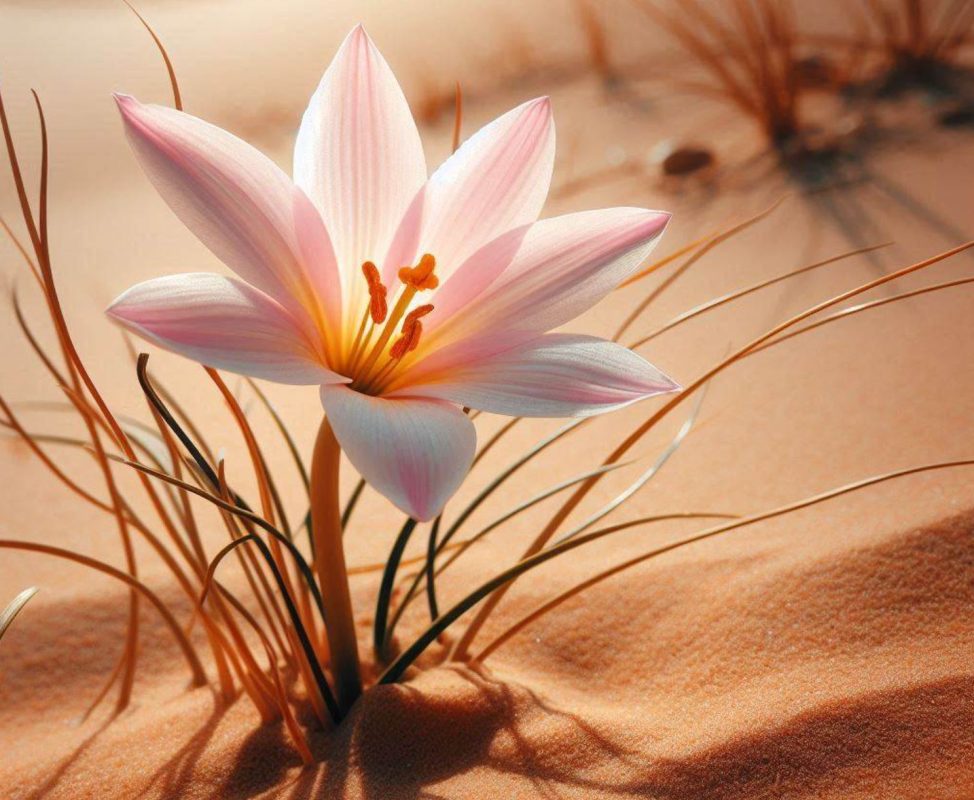
Cretan sand lily from Wikimedia Commons


P.S. You’ll be seeing quite a bit of Minoan-inspired poems from me this month because it’s National Poetry Month/NaPoWriMo. 😀

  1. Seabirds of the genus Larus were likely present in ancient Crete. ↩︎
  2. Also known as a sea daffodil or sea lily (Pancratium maritimum), the sand lily is native to Crete and has been around since prehistoric times, with the Minoans depicting it in their art. ↩︎
  3. “king” in Mycenaean Greek (pronounced as wa-na-ka in Linear B). While not directly associated with Minoan rulers, there is evidence of kings in Minoan Crete, but there is no known word for them. ↩︎

Minoan Spring (a poem)

a researched poem about the vernal equinox in Ancient Crete

Warm westerly winds replace the biting gales of the north.
Crocus, poppy, and lily saplings slowly spring forth.
Rainy season makes its anticipated exodus as March wanes,
the sunshine igniting a mountainous scene amidst flowery plains.

The Mother Goddess’ blessings are ever-bountiful,
and so, her devotees honor her with a vibrant spring festival
brimming with offerings, worship, sacrifices, and ecstatic dance
to ensure another year of fertility, flourishment, and favorable circumstance.

In the sustained daylight and deep into the night,
they jubilantly celebrate the cyclical rhythms of life
and their spiritual ties to the natural world—
whether olive, boar or bee, existence ebbs and unfurls.

a close-up of the Spring Fresco from Akrokriti, depicting a rocky landscape with lilies and swallows

A Neophyte Bull-Leaper’s First Leap (a poem)

a mythological poetic story about a nervous yet brave novice bull-leaper (inspired by “The Bull-Leaping Fresco” and Martis, the main character of Eleanor Kuhn’s book “On the Horns of Death”)

an ivory figurine of a bull-leaper recovered from Knossos, 1600–1500 BCE

Body frozen in place by neophyte’s first-leap nerves.
Neither a blink nor a breath as she nears her turn.

First, it is her soul who leaps out of her chest and enters the ring
as a bull white as ivory charges towards her in full swing,
galloping hooves syncing with her quickening heartbeat.

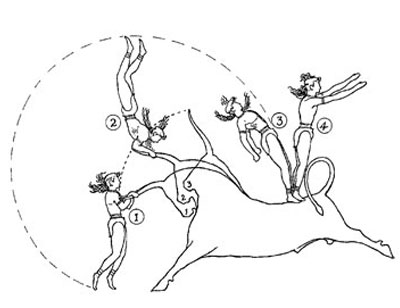
And so, she grabs the creature by the horns and flips,
ironclad her determination and grip,
then smooth as still sea, vaults over its back,
landing feet first assuredly upon the sand.

But as her turn arrives in real-time, she averts her eyes
and side-steps, barely veering from her demise.
Her fellow leapers try to pull her from the bull’s line of sight,
yet she remains a pillar unmoving; she must give it another try.

So, as the bull comes back around,
heaving as it tires from countless rounds,
she takes a deep breath and braces herself,
and as if divinely guided by The Goddess,
grasps the beast by the horns with calloused hands,
vaults, and lands, freezing in place upon his coarse back.
Her arms quiver in both excitement and fear
while her comrades gasp and cheer.

a line drawing by Sir Arthur Evans depicting the steps of bull-leaping