
Ariadne (Greek: Ἀριάδνη) was a Cretan princess and the daughter of King Minos (the mythic king that the Minoans were named after) and Pasiphae (a sorceress and daughter of Helios). Upon her death, she was regarded as a goddess of labyrinths and paths.

Ariadne by John William Waterhouse (1898)
The Myth of Ariadne: Princess Turned Goddess
There are several versions of Ariadne’s myth, but she is best known for overseeing the labyrinth where sacrifices were made. Putting an end to these atrocities once and for all, she ended up assisting Theseus in his escape from the Minotaur (a half-bull, half-man creature) with a ball of thread, only to be abandoned by him at Naxos. Exhausted and heartbroken, she fell asleep at the island’s shore. Dionysus (god of wine and festivity) happened to see her, and it was love at first sight. They later married, and as a sign of his devotion, Dionysus tossed Ariadne’s bejeweled crown into the heavens, creating the Corona Borealis1. Her goddess status came after she died when her grief-stricken husband traveled to the Underworld and brought her back to life so they could be together forevermore.

Bacchus (Dionysus) and Ariadne by Giovanni Antonio Pellegrini (1720)
A Goddess of Pre-Greek Origins
While Ariadne is prominent in Greek mythology, linguist Robert S. P. Beekes and archaeologist Stylianos Alexiou have theorized that she had a pre-Hellenistic origin. The main reason is due to her name including “dn” (δν), which is particularly rare in Indo-European languages. Therefore, that points to her name stemming from Minoan loanwords2. Furthermore, Greek lexicographers have claimed that Ariadne is derived from the ancient Cretan dialectical elements: “ari” (ἀρι: most) and “adnós” (ἀδνός: holy), so The “Most Holy” One3.
Yet another aspect to Ariadne is that of a Minoan fertility goddess. Could it be that Ariadne was the Minoan’s mother goddess repurposed/re-imagined by the Greeks?
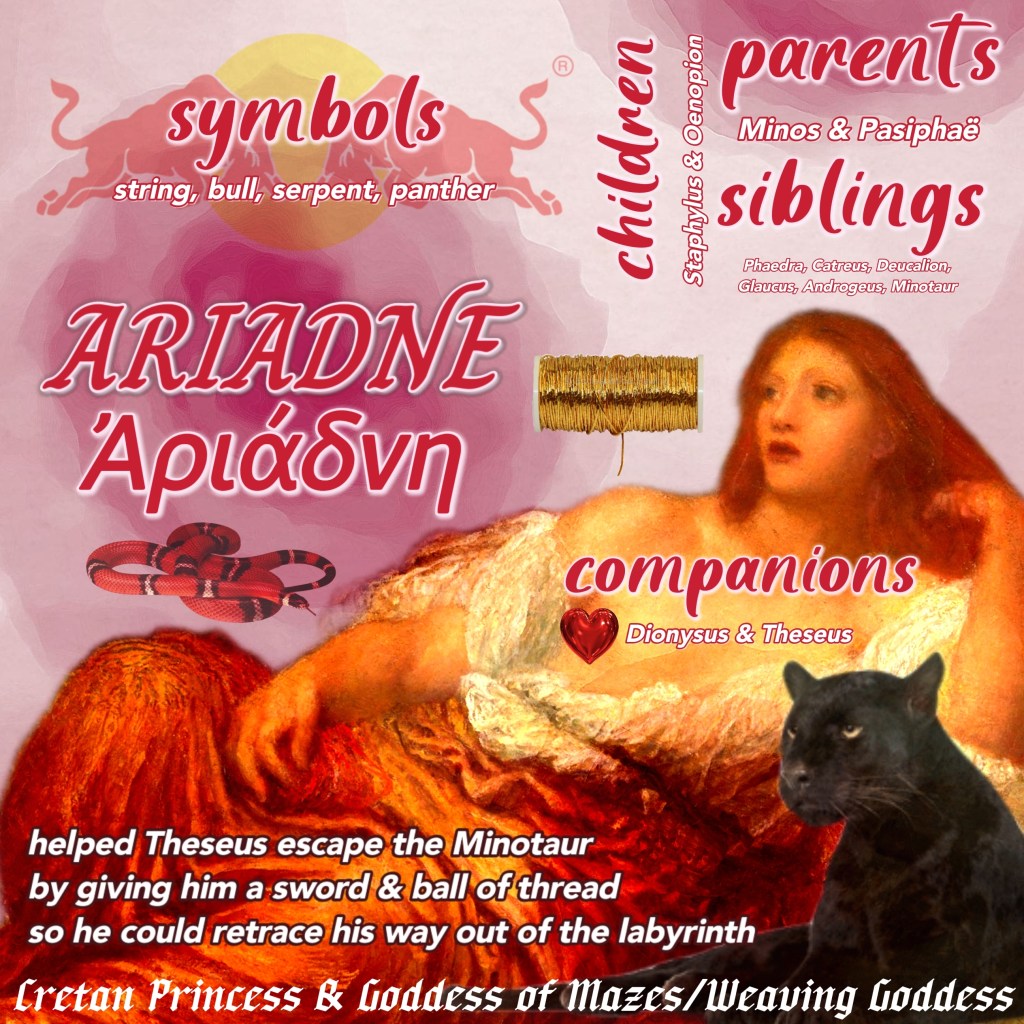
Some more information about her is included in the infographic I created below:



 Minoan Magissa