Ariadne: The Formidable Princess of Ancient Crete

Ariadne (Greek: Ἀριάδνη) was a Cretan princess and the daughter of King Minos (the mythic king that the Minoans were named after) and Pasiphae (a sorceress and daughter of Helios). Upon her death, she was regarded as a goddess of labyrinths and paths.

a painting of Ariadne in a reclining position with two leopards nearby. She is by a harbor.

Ariadne by John William Waterhouse (1898)

There are several versions of Ariadne’s myth, but she is best known for overseeing the labyrinth where sacrifices were made. Putting an end to these atrocities once and for all, she ended up assisting Theseus in his escape from the Minotaur (a half-bull, half-man creature) with a ball of thread, only to be abandoned by him at Naxos. Exhausted and heartbroken, she fell asleep at the island’s shore. Dionysus (god of wine and festivity) happened to see her, and it was love at first sight. They later married, and as a sign of his devotion, Dionysus tossed Ariadne’s bejeweled crown into the heavens, creating the Corona Borealis1. Her goddess status came after she died when her grief-stricken husband traveled to the Underworld and brought her back to life so they could be together forevermore.

Bacchus (Dionysus) and Ariadne by Giovanni Antonio Pellegrini (1720)

Bacchus (Dionysus) and Ariadne by Giovanni Antonio Pellegrini (1720)

While Ariadne is prominent in Greek mythology, linguist Robert S. P. Beekes and archaeologist Stylianos Alexiou have theorized that she had a pre-Hellenistic origin. The main reason is due to her name including “dn” (δν), which is particularly rare in Indo-European languages. Therefore, that points to her name stemming from Minoan loanwords2. Furthermore, Greek lexicographers have claimed that Ariadne is derived from the ancient Cretan dialectical elements: “ari” (ἀρι: most) and “adnós” (ἀδνός: holy), so The “Most Holy” One3.

Yet another aspect to Ariadne is that of a Minoan fertility goddess. Could it be that Ariadne was the Minoan’s mother goddess repurposed/re-imagined by the Greeks?

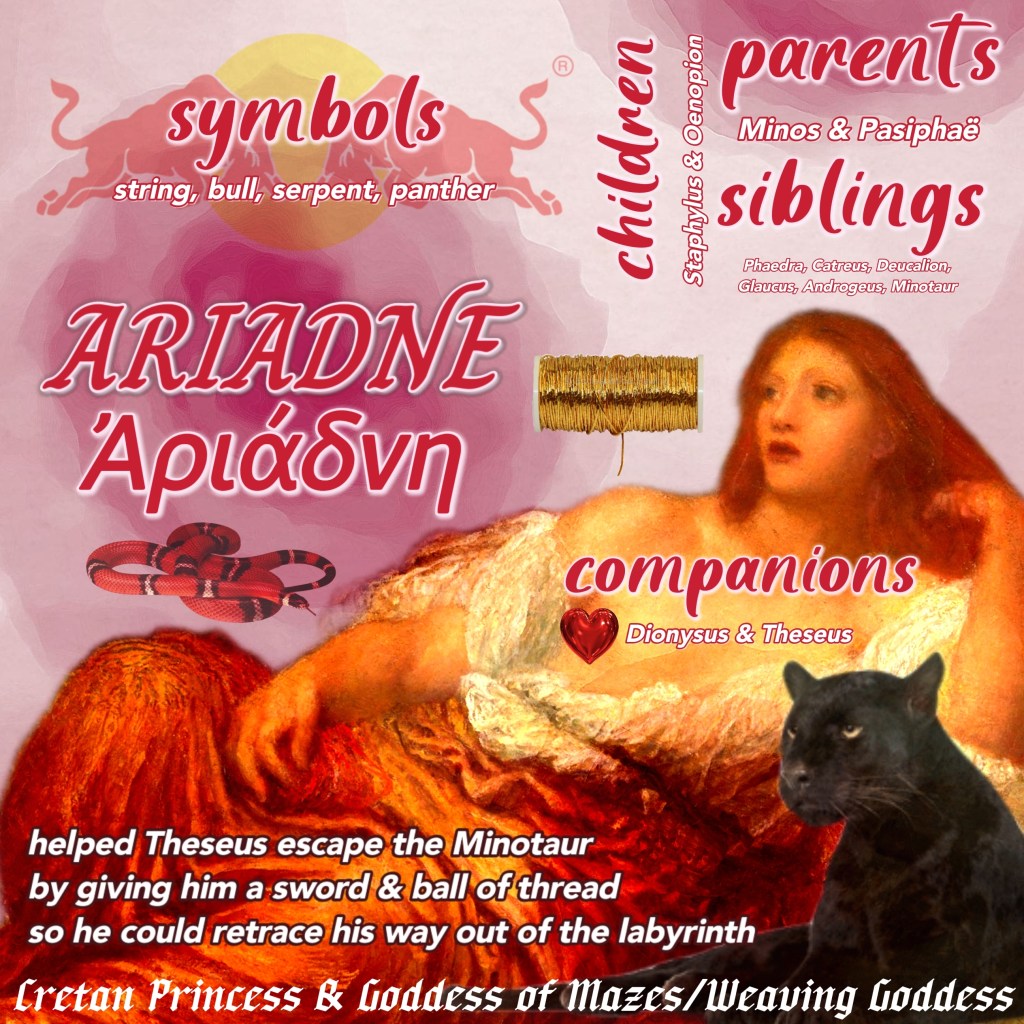
Some more information about her is included in the infographic I created below:
  1. Hall, James (2018). Dictionary of Subjects and Symbols in Art ↩︎
  2. Beekes, Robert (2010). Etymological Dictionary of Greek: Volume I ↩︎
  3. Hanks, Patrick; Hodges, Flavia (1997). A Concise Dictionary of First Names ↩︎

Minoan Tarot Deck by Ellen Lorenzi-Prince (Review)

I’d like to start this post with some backstory. About a year or so ago, when I was doing a deep-dive into my Cretan ancestry, I was on the lookout for anything that could really help me connect beyond books, articles, and memories from all the summers of my childhood and early adulthood spent on that magical island. I recreated traditional costumes and rituals, bought jewelry replicas to wear, visited art museums with Minoan artifacts, and created this blog to share my findings.

As a mystic with a vast tarot and oracle card collection (and I mean vast!), I figured I’d try my luck and search for a Minoan-inspired deck. Admittedly, I wasn’t too confident anything would turn up, but I soon came across Ellen’s beautiful deck. My soul lit up, and I saw there was only one deck left for sale on Etsy at the time (lucky me!), so I immediately ordered it. I purchased it a few weeks before my birthday, and it was actually delivered on the day (perfect timing!). The 78-card deck arrived complete with a well-researched booklet and sturdy box. There were also several freebies: a small magnet of the Oracle card (featuring the Snake Goddess/Priestess), a bigger photo card of the Sun card, and a sweet personal note.

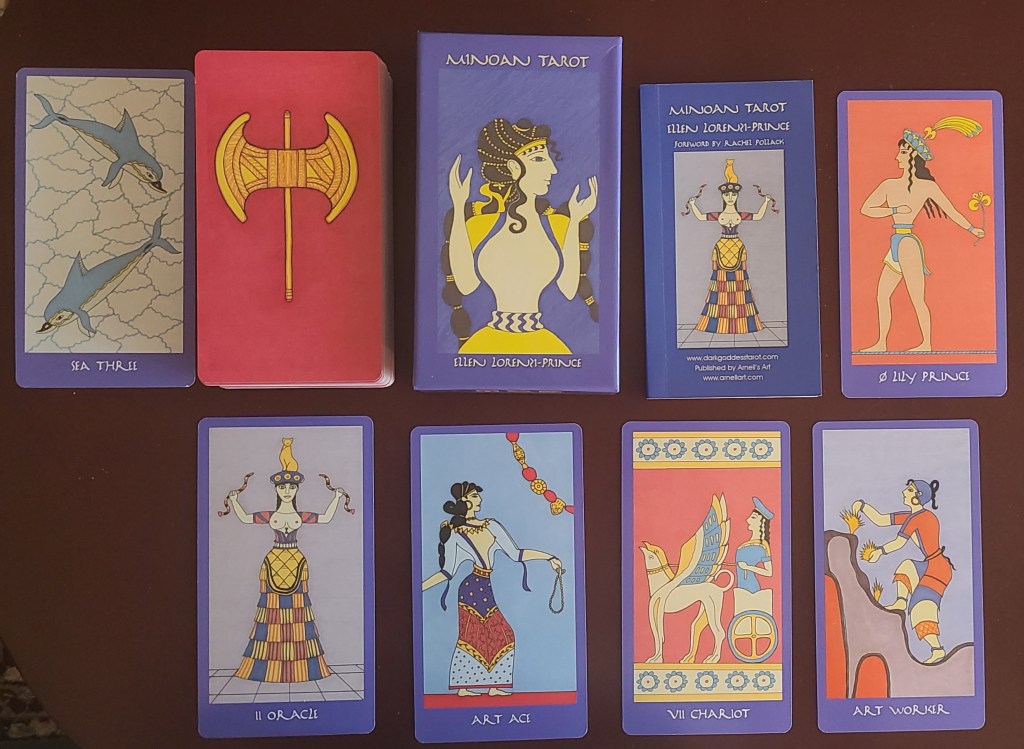
Just me going through the entire deck real quick – the artwork is stunning!

The deck at a glance. The back of the cards feature the labrys. The box and booklet are at the upper center.

The descriptions for every card are well thought out, insightful, and detailed with useful key points at the end of each one. They definitely teleport you to ancient times, to say the least. The only downside is the quality of the booklet itself. The text is a little close to the binding, so in opening it to properly read everything, some pages fell out. It’s also difficult to take pictures of the inside as a result. Other than the need for stronger binding and some typo corrections, everything is high quality: the information, the art, the cards (with a glossy finish), and the artful box (featuring the Star card). I also love that there are unique suits that go beyond the standard Rider-Waite deck.

For someone who was looking to better connect with their roots, this deck did just that. Cretan or not, these cards will absolutely draw the magick of the Minoans into your life. Anytime I’ve selected a card, it’s been spot on, often eerily so, and I learn more about the featured art and symbols along the way.

That all being said, I give this deck a rating of 4.5 stars! You can tell how much of her heart and soul were put into the making of these cards. Thank you, Ellen, for creating something that’s been integral to my spiritual practice.

To find out more about this deck and/or to order your own, go here: www.DarkGoddessTarot.com/Minoan.htm

First post of 2023!

Hi everyone! It’s been a while since I’ve posted last, and I definitely want to create blog posts more consistently this year, but can’t make any promises. 2022 was a whirlwind year full of self-discovery, unexpected upheaval, and a lot of my focus went into my devotional art and poetry book “To the Greek Muses”. Anyway, here are a few posts you can (hopefully) expect in the coming months (in no particular order):

1. An honest review of the Minoan Tarot Deck by Ellen Lorenzi-Prince

2. More Minoan-inspired ritual ideas

3. A list of artists who create Minoan jewelry as well as reviews

4. Minoan-inspired outfit #2

Are there specific topics you want to read more about?