I put together this playlist to teleport others to the time period of the Minoans. While we can’t know for sure what their music was like, I appreciate all these inspired compositions with some Ancient Greek flair. One musician even crafted a Minoan instrument that was depicted in a fresco (see featured image), and he tested his creation, which honestly sounds amazing! This playlist works well for fellow mystics who do ritualwork and folks with Greek and especially Cretan ancestry who would like to feel more of a connection to their ancestors.
That final track is more on the humorous side, but I appreciate its cleverness and (mostly) historical accuracy. 🙂
*I added a collaboration function in case anyone comes across any Minoan-inspired songs I may have missed. Go here to add a video.
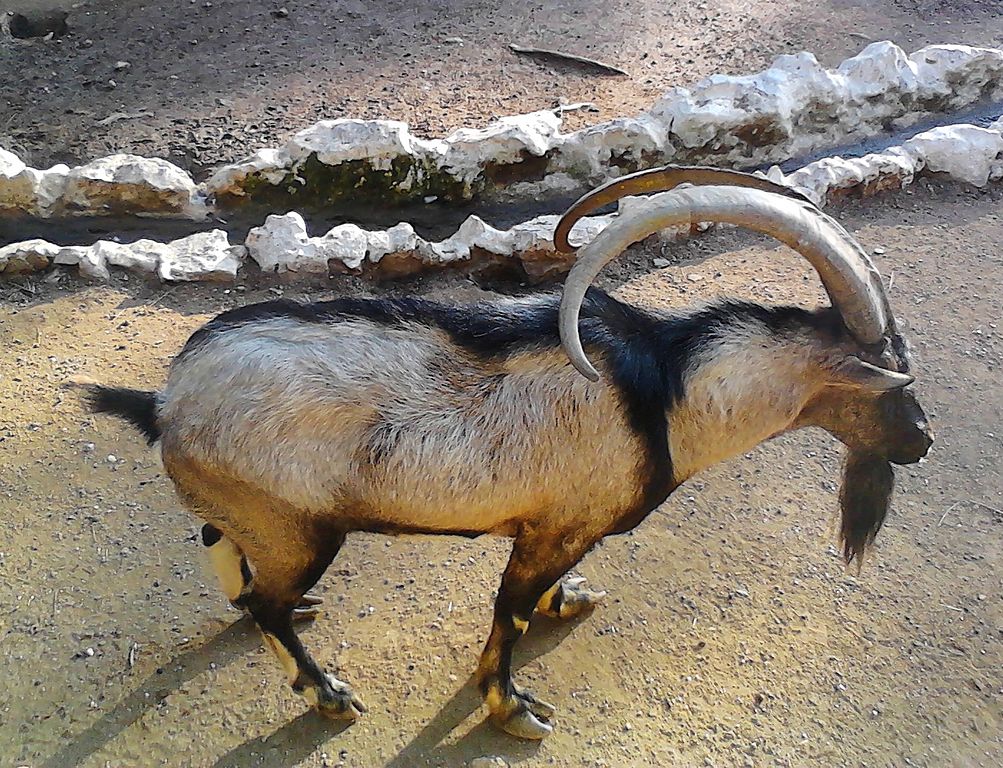
The Cretan goat (or kri-kri) is a creature of Minoan times that is still in existence to this day. It’s considered a feral goat endemic to Crete that also happens to be the island’s main symbol. This particular goat is commonly referred to as an agrmi (αγρίμι: “the wild one”, wild beast” or “full of fury”) amongst Cretans. Its female counterpart is called a sanada (σανάδα).
Credit: Ανώνυμος Βικιπαιδιστής
Key Traits of the Cretan Goat
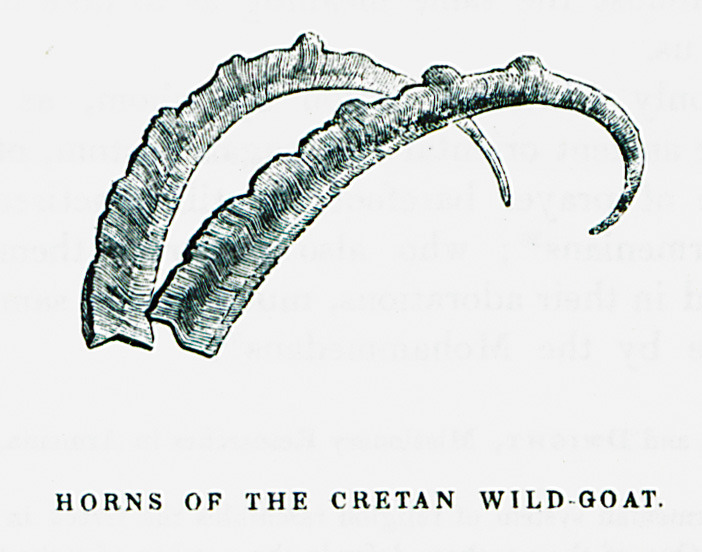
The kri-kri’s coat is coarse and light brown, with a black band around the neck on males. Moreover, it’s a double coat, consisting of an outer layer of longer, coarser hair (guard hair) and a soft undercoat (underwool). Their two horns that curve back are noticeably longer on agrimia than sanades. As for their extra-long hooves, they are cloven, which means that they’re split into two main hooves that work independently of one another. It also has two dewclaw hooves higher up its pastern (ankle), which are ideal for climbing cliffs and landing their large leaps without falling.
Out in the wild, the Cretan goat possesses a timid demeanor and avoids humans whenever possible but when cornered or taunted, they may respond by lowering their heads, pulling in their chins, and showing their horns.
Credit: Robert Pashley
The Agrimi’s Origins
The agrimi was most likely imported to the island during the Minoan period. Molecular analyses also demonstrate that this goat is not considered a distinct subspecies of wild goat as formerly posited. It is, in fact, a feral-domestic goat obtained from the initial stocks of goats domesticated in the Levant and various parts of the Eastern Mediterranean in approximately 8,000 BCE.
A Protected Species That’s Still Under Threat
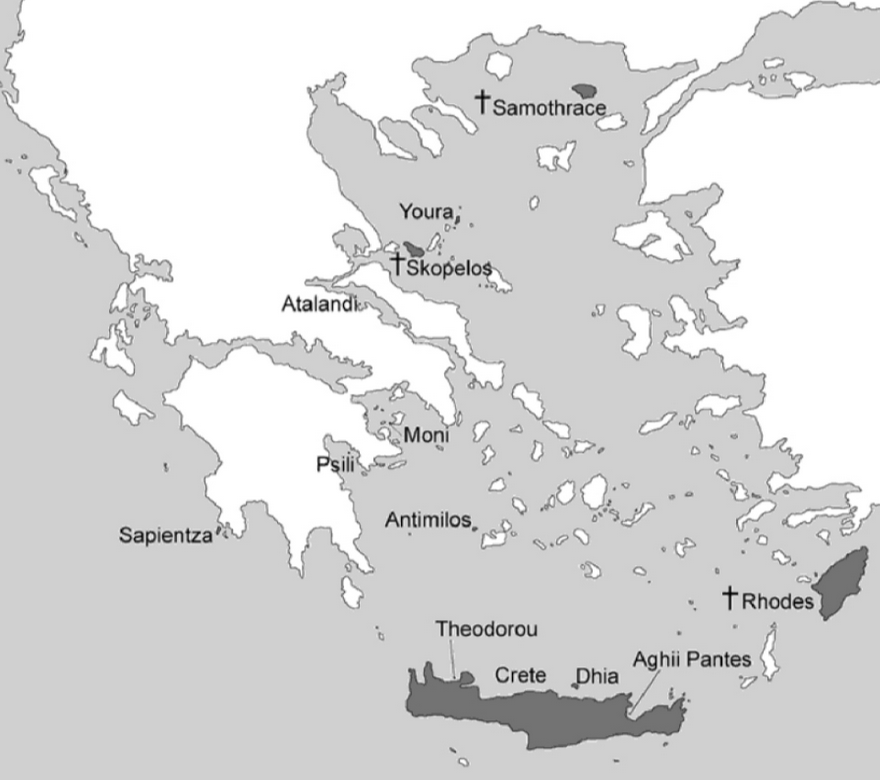
Credit: Marco Masseti
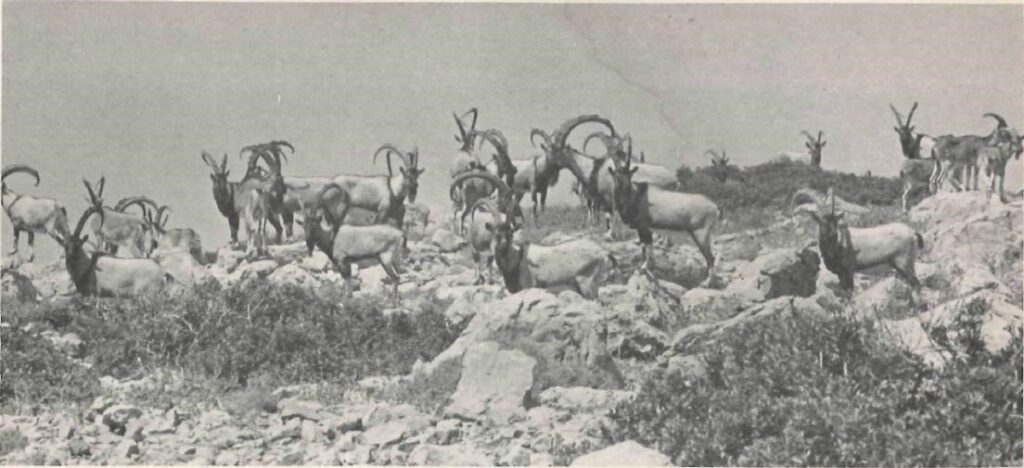
Capra hircus cretica was once common throughout the Aegean but the peaks of the White Mountains of Western Crete are presently where its most prevalent. This area hosts over a dozen endemic species and is protected by UNESCO’s (United Nations Educational, Scientific and Cultural Organization) Biosphere Reserve in Samaria Gorge. Agrimia also extend into the Samaria National Forest and the isles of Dia, Thodorou, and Agioi Pandes. To grow their numbers, they’ve recently been introduced onto two additional islands.
Despite all these efforts, the kri-kri is deemed “Near Threatened” globally by the IUCN (International Union for Conservation of Nature) as of 2025 due to habitat loss, hybridization with domestic goats, and poaching.
Back in 1960, this emblematic animal was at its most threatened, with a population just over 100. The main reason for this is that it had been the only meat source available to freedom fighters during World War II’s German occupation. Thankfully, Samaria Gorge became a national park two years later!
A Sacred Symbol
Not only is the kri-kri a primary symbol to modern-day Cretans, but it was also sacred in antiquity. Many depictions have been found by archaeologists in Minoan art, including the Minoan rhyton (drinking vessel) pictured above. This has caused some academics to surmise that the Cretan goat was worshiped and had ties to the Greek god Pan, the half-goat deity who presided over the wild, shepherds, and flocks.
Today, the agrimi represents the free spirit, grit, and determination of the Cretan people. It also embodies the island’s rugged landscape and the perseverance necessary to traverse it. I didn’t understand the reference at the time, but I’d be compared to an agrimi as a kid when I’d be outside playing with my friends all day long, paying no mind to skinned knees, sweaty clothes, and dirt on my hands and legs. “The Wild One”… Quite fitting indeed.
Sources
Bar-Gal, G. K. et al.: Genetic evidence for the origin of the agrimi goat (Capra aegagrus cretica). Journal of Zoology.
Mantinades (derived from the Venetian matinada: morning song) are Cretan folk poems/songs that consist of rhyming couplets at 15 syllables per line (called dekapentasyllabos) in a Cretan Greek dialect (mine’s a little rusty; I made do, though). Usually, one couplet can stand alone and they are improvised. But often being antiphonal in nature, a verse elicits a response, so the verses can be many. This poetic form initially appeared in Crete during the 15th century, which coincided with the period of Venetian rule over the island.
Seeing as the Greek and English languages differ a great deal, my translations will be 10 syllables per line and the meanings may vary somewhat to maintain a rhyme scheme.
During my summers in Crete, mantinades were recited at gatherings accompanied by the Cretan lyra and laouto or in everyday conversation. My γιαγιά (grandma) would often tell me a few that her mother passed down to her and so forth. She’d say them so many times that I remember some by heart. Here’s one of them that she’d recite when she’d wake up at dawn to take care of her animals and crops and was especially groggy:
Νυστάζω και κλονήζω και ποίος θα πάει στο μύλο; 《Άσου ρε κυρία και εγώ θα πάω στο μήλο!》 I’m exhausted. Who will go to the mill? “Stay put. I’ll go to th’orchard by the hill!”
Funnily enough, it took me until now to realize the true meaning behind it! I wondered why she’d use the exact same word for the “rhyme”, but she didn’t. There are two kinds of “milo” spelled slightly differently: a mill and an apple orchard. So basically, the person reciting this doesn’t really want to go to work but knows they have to. The other person who offers to help conveniently mishears, which further reiterates that no one is going to do their appointed job but themselves.
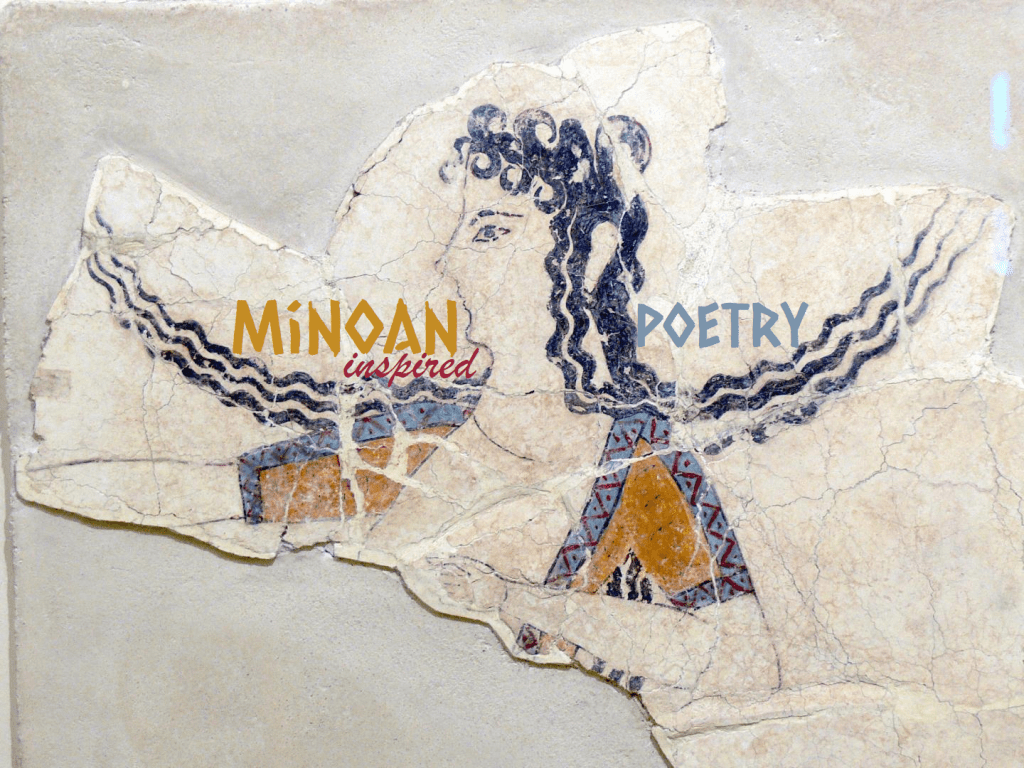
Minoan Woman Fresco Fragment. Photo Credit: Wolfgang Sauber
But you’re probably here for the Minoan-inspired poems! Here’s a modern-meets-ancient spin on classic mandinades…
Island Girl
Original Greek Version:
Ήντανε τούτο που ερχόντας απ’ μέρος μακρινό, που ξανοίγω με τα Θολωμένα μάτια μου τα δυό;
Θωρώ ματιά κρυστάλλινα σαν ηλιόλουστα νερά και ρούχα μπαλωμένα με κουρασμένα πρόσωπα.
Transliteration:
Íntane touto pou erchóntas ap’ méros makrinó, pou ksanígo me ta tholoména mátia mou ta dyó?
Thoró matiá krystállina san iliólousta nerá kai roúha baloména me kourasména prósopa.
English Translation:
What is this from such faraway isles that I observe with these eyes beguiled?
I see eyes crystalline like sunlit seas with weary faces and clothes frayed at seams.
*about a rich isolated Minoan girl seeing outsiders for the first time. Most Minoans being dark-haired with dark eyes and olive skin, seeing pale blue eyes would probably be quite the shock as well as clothing that isn’t as vibrant and elaborate as theirs.
Bedecked for Spring’s Blessings
Original Greek Version:
Φορώ τη καλύτερη μου φούστα με μπλέ φυλαχτό. Απόψε Η Θεά θα μας φέρει άνεμο θερμό.
Transliteration:
Foró tin kalýteri mou foústa me blé fylahtó. Apópse I Theá tha mas férei ánemo thermó.
English Translation:
I wear my best skirt with my blue pendant. Tonight, The Goddess will bring us warm wind.
*about a Minoan woman who dresses her best to attend the spring festival in order to ask The Goddess for the warm winds that will bring everything to life. The Minoans took pride in their sense of style in general, but they especially had to bedeck themselves during festivals and other important events out of respect.
Leaping in Secret
Original Greek Version:
Ξέφυγα κρυφά για ταυροκαθάψια το πρωί. Ευτυχώς η μαμά και γιαγιά δεν πήραν χαμπάρι!
Transliteration:
Kséfyga kryfá gia tavrokathápsia to proí. Eftychós i mamá kai yiayiá den píran habári!
English Translation:
I snuck away at dawn for bull-leaping. Good thing mom and grandma were still sleeping!
*about a Minoan girl who is secretly practicing bull-leaping against her family’s wishes. Inspired by the character Martis in In the Shadow of The Bull by Eleanor Kuhns. However, it’s important to note that sports were not limited to men only in Minoan society. Still, families presumably wished for their children to survive into adulthood and marry. Bull-leaping wasn’t exactly a safe sport…
An Enamored Girl’s Plea to the Goddess
Original Greek Version:
Αυτό το κουζουλό κοπέλι δεν κατέει πράγμα. Πάω σε κάθε απόδοση. Θεά, δως μου θαύμα!
Transliteration:
Aftó to ómorfo kopéli den katéei prágma. Páo se káthe apódosi. Theá, dos mou thávma!
English Translation:
This silly guy, the truth he doesn’t see. I attend all his gigs. Goddess, guide me!
*about a Minoan girl who is in love with a silly, clueless boy. He’s somehow still oblivious even though she’s been at every single bull-leaping performance he’s in. I’d imagine matters of the heart would be petitioned to The Goddess. These pieces really aren’t meant to be entirely historically accurate.


 Minoan Magissa