Flowers of Minoan Crete: Saffron Crocus (Crocus sativus)

Cultivated on the island of Crete as early as the Middle Minoan Period (2,100 to 1,600 BCE), the saffron crocus (the precursor to Crocus cartwrightianus) has been an integral flower to the Minoans and Modern Cretans alike. It has been depicted in frescos (i.e. “Saffron Gatherers”) and ceramics, used in cosmetics and perfumes, utilized as a spice and medicinal, and was a prevalent colorant in general.

But before we dive any deeper, it’s important to note that saffron is derived from the saffron crocus itself. More specifically, the spice (saffron) consists of the reddish-orange threadlike structures of the flower called stigmas. Crocus sativus is actually the only Crocus species that yields saffron.

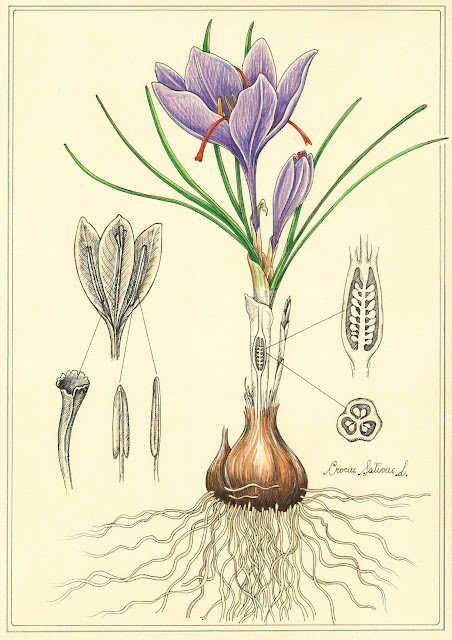
Illustration of Crocus sativus

The saffron crocus is related to the iris and is considered an autumn-blooming crocus (late September to early October). It is also characterized as a cormous perennial, meaning that it grows from a tuber/bulb like a tulip and returns year after year.

Crocus sativus can grow to be 30 centimeters high. As mentioned, it develops as a bulb underground which in turn produces leaves, bracts, bracteole, and the flowering stalk. Its blooms tend to be a deep purple and have six petals and three stigmas. Its leaves are rosulate (arranged in the form of a rosette; a cluster of grasslike leaves radiating from a central point).

With the flower only producing three stigmas, it’s safe to say it takes a large volume of flowers to yield a small amount of saffron (we’re talking up to 75,000 individual plants in order to produce one pound of saffron), thus making it the most valuable spice of the ancient and modern worlds. Harvesting was indeed labor-intensive but also ritualistic to the Minoans. In fact, it continues to be culturally significant in Greece, with non-mechanical saffron cultivation remaining a tradition throughout the country, especially in Crete.

The medicinal component of saffron stems from its concentration of potent carotenoids (antioxidants crocin and crocetin).

Saffron dye is vibrant yellow to orange. It is water-soluble with a high tinctorial strength, meaning its vivid color in small amounts goes a long way. This striking color comes from the carotenoid compound crocin, which makes it particularly resilient to sunlight.

In addition to frescoes, ceramics and makeup, the dye has been used in fabrics, and signified prestige and elegance.

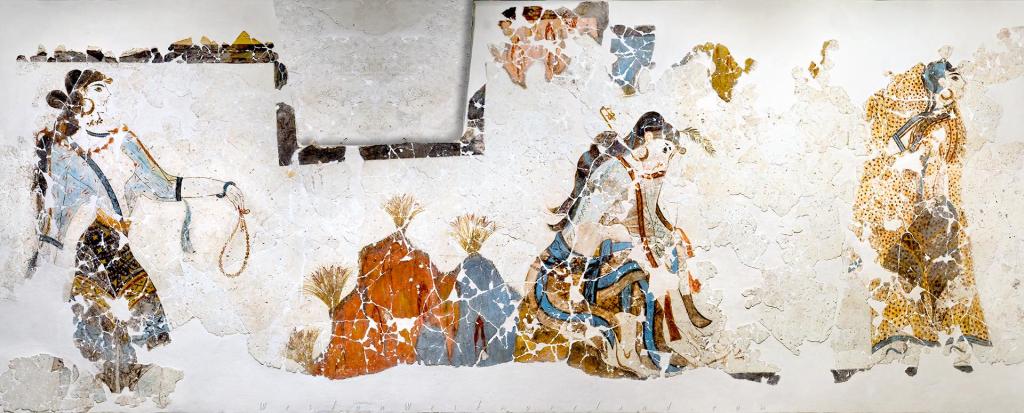
"Adorants Fresco" of three women of various ages adorned in saffron

Saffron served as a cornstone of culture and identity for Minoan women in particular. In virtually every scene of saffron crocuses, solely women have been depicted. This leads scholars to posit that saffron was a gynecological remedy (among others) that was used by midwives and female healers alike. One such scene is featured in the “Adorants Fresco” (see above) that originally adorned the walls surrounding a ceremonial basin. Along the north wall, three women are shown headed toward a shrine on the east wall. Crocuses and saffron stigmas make appearances on the vibrant garments of all three: the older woman to the left walking towards the shrine wears a blue blouse decorated with crocus flowers and a garland of crocus stigmas around her neck and shoulders, the seated woman in the middle wears a belt embellished with crocus flowers as she nurses her wounded foot, and the youngest person on the right wears a yellow veil speckled with red and a crocus-adorned bodice. Beyond its medicinal properties, this scene also displays an initiatory rite from girlhood to womanhood.

The intersection between saffron and divinity can be seen in an early-20th-century discovery by Arthur Evans at Knossos. As the Temple Repositories were revealed, an array of ritualistic faience objects were discovered. Amongst them were faience crocuses that served as votive offerings and models of crocus-adorned garments.

The versatility of the saffron crocus cannot be emphasized enough. This multi-functional crop was valuable in all avenues of Minoan life, from economical to religious. Millennia later, and it is still one of the most sought-after spices known for its subtly sweet and earthy flavor with floral notes.
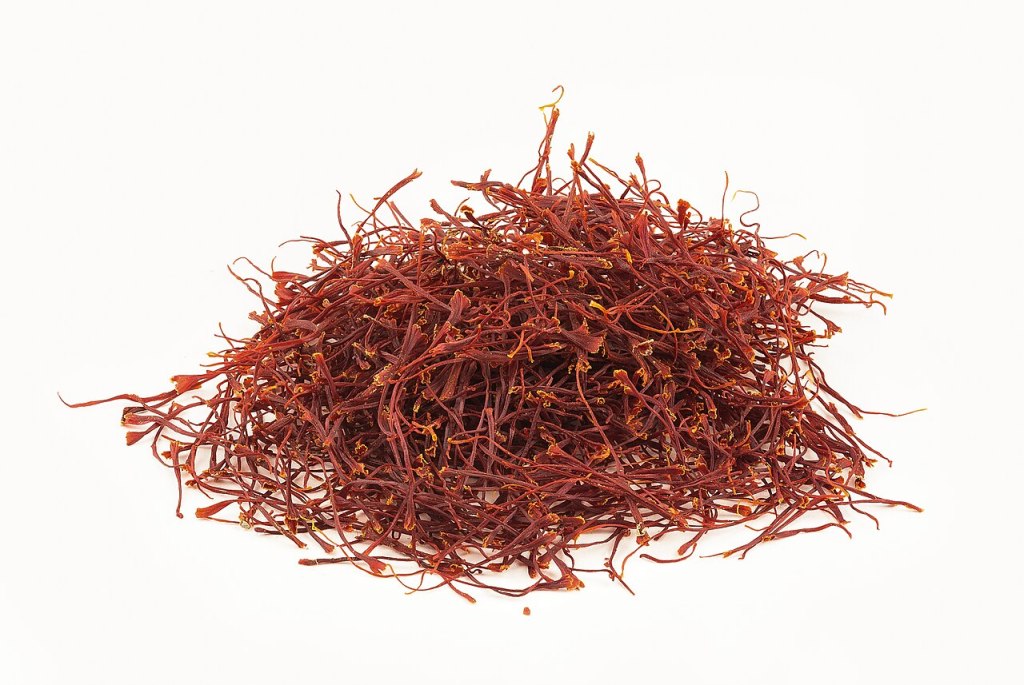
a clump of saffron threads

The Many Names of Crete Through the Ages: From Kaptara to Krētē

Before Crete (Κρήτη: Krētē) was, in fact, called Crete, it was referred to as Kaptara (its earliest known reference, c. 1800 BCE) in Syrian and Neo-Assyrian, Keftiu (Kftı͗w, c. 1480 BCE) in Ancient Egyptian, and Caphtor in the Bible.

An old map of Achaean Crete in color

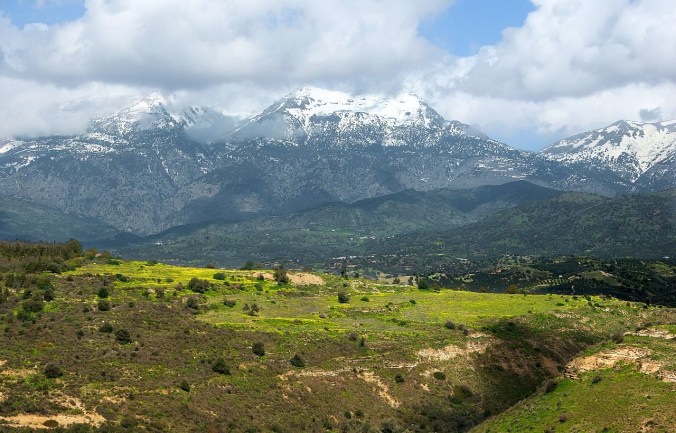
Many scholars deem Keftiu to be more similar to the Minoan name than “Minoan” ever was, which may be derived from the Greek word for “the nail of the earth” or “the peak of the mountain”. This phrase refers to the dominant peak of Crete (Mount Ida at 8,058 feet), which was a well-known landmark for seafarers. The Middle and Late Egyptian versions were as follows: Keft, Keftu, Kaftu, Kafta, Kefdet, Keftju.

Mount Ida in Rethymno, Crete
Mount Ida. Credit: Jebulon

However, it is important to note there’s been much debate over what Keftiu is truly referring to. While some scholars say Cyprus or Syria, the stone base of a statue during Amenhotep III’s reign states otherwise. Kftı͗w is in a list of Mediterranean ship stops to Cretan cities like Kydonia and Phaistos, which clearly points to the Aegean, not Anatolia.

Its initial Crete-adjacent iteration was found in Mycenaean Greek texts dating back to around 1,500 BCE. In Linear B, it was written as 𐀐𐀩𐀳 (ke-re-te) at first. Later on, it took on the names 𐀐𐀩𐀯𐀍 (ke-re-si-jo), Κρῆτες (Krētes), and Κρήσιος (Krēsios).

In Ancient Greek, Crete’s current name (Κρέτα (Kréta) to the ancient Doric Greeks) first appeared in The Odyssey. While its etymology isn’t entirely certain, there are two main propositions. The less likely notion between the two is that Crete could stem from a hypothetical Anatolian Luwian word kursatta (kursawar: island). However, there’s more of a consensus surrounding its Ancient Greek origins. Crete could very well stem from “κραταιή” (krataie̅), which means strong or stronghold, reflecting the fact that the island was the strongest thalassocracy (maritime empire) in the ancient world.

Interestingly, κριτικός (krētēkos), which is a homonym of Κρητικός (what you call a Cretan man), means “able to discern or be critical.” Though this is simply something I personally noticed, this could relay to their command over both rugged terrain and tumultuous sea, and the critical thinking involved in traversing both.

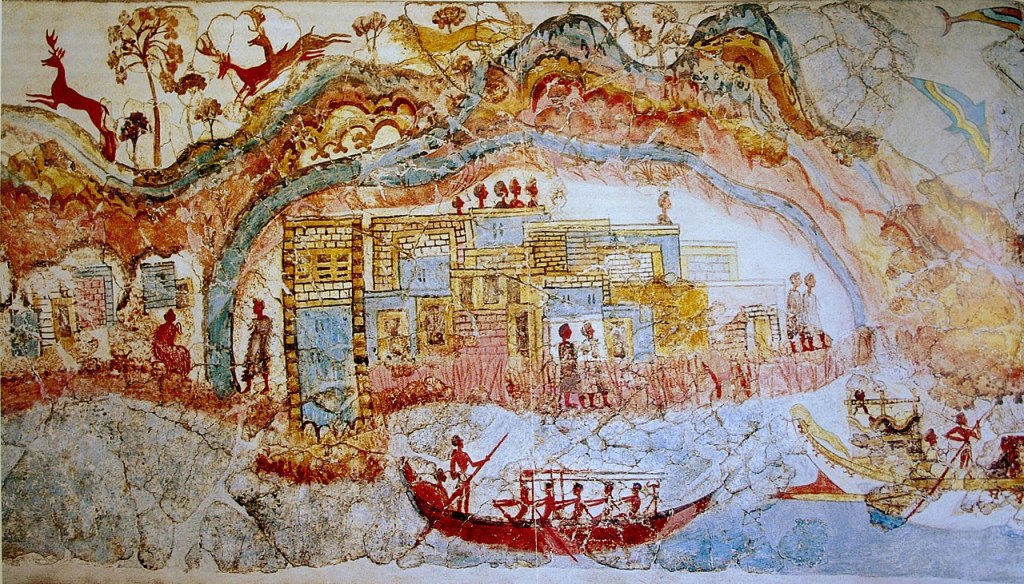
The Ship Procession or the Flotilla frieze

Another near-homonym could just be another interesting coincidence, but when it comes to Caphtor, that is very similar to the word for “hot” in Greek (kaftó: καυτό). Crete has a temperate Mediterranean climate, which means summers are hot and dry. I can even attest to the intense heat having stayed at my γιαγιά’s non-airconditioned house during many a summer.

I’d definitely take the above thoughts with a grain of salt because the closest Greek word to Keftiu is keftés (κεφτές), which means “meatball”. While κεφτέδες are a Greek delicacy, the two words are clearly not related. It’s just interesting to me that some foreign names for Crete actually hold relevant meanings.

From Kaptara to Krētē, the ‘k’ sound has (mostly) remained since its very first known iteration. However, what has been mentioned isn’t all-inclusive. In Latin, Crete is Creta, whereas the original Arabic name was Iqrīṭiš (اقريطش) and then changed to Χάνδαξ (Chandax).

Candia, derived from the French Candie, was used in Latin, Italian, and Venetian. In Ottoman Turkish under Ottoman rule, Crete was called Girit (كريد: precious stone), which brings up another uncanny coincidence. My μαμά’s Cretan maiden name means precious stone, which I won’t mention here for privacy reasons. The “-akis” suffix was added later on, which means “small”, changing the name meaning to pebble. While that’s a point of pride during modern times, that was added to Cretan surnames during the Turkish occupation to demean Cretans.

  • Caphtor/Keftiu: A New Investigation by John Strange
  • The Aegean Bronze Age by Oliver Dickinson

Communing with My Ancestors at Knossos (a poem with photos)

a piece about my unforgettable visit to the Palace of Knossos that connected me to my ancestors in a way nothing else has…

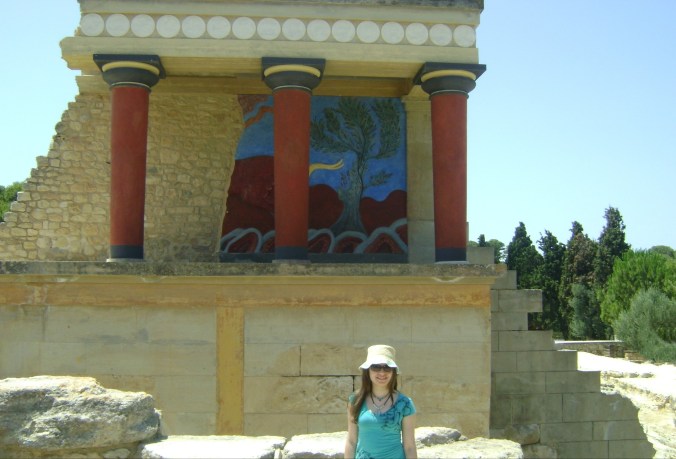
Me by the Restored North Entrance with the Charging Bull fresco
me by the Restored North Entrance with the Charging Bull Fresco

Mid-July sun scalds skin and ancient sites indiscriminately
and illuminates the same steps my ancestors took thousands of years ago.
The trickles of sweat down my brow are overshadowed by
the tingle up and down my spine as I approach
pithoi1 that once contained oil from olive trees that may still live to this day,2
vibrant frescoes that still echo the artistry of masterful Minoans
despite destruction by both nature’s and occupiers’ hands
and some questionable reconstructions,
labyrinthine paths that, along with midday heat, further dizzy me.

Knossos stonework, paths, and stairs
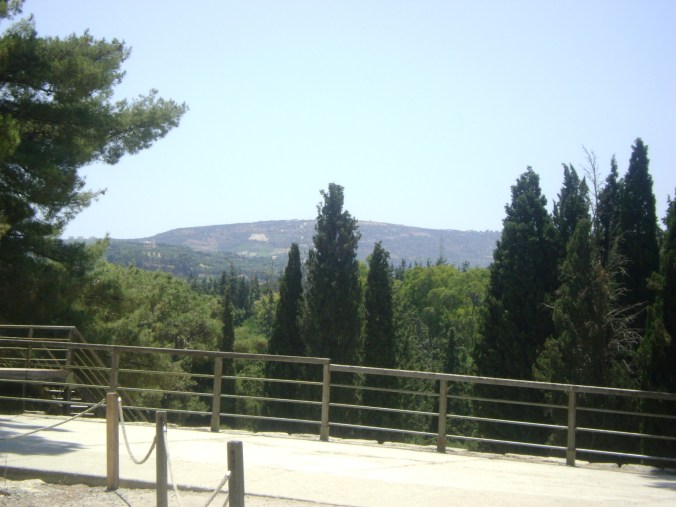
the view from Knossos

Mouth dry but mind bedazzled by
Mount Juktas (Γιούχτας)3 nearby
and Kephala Hill (Κεφάλα)
upon which Knossos (Κνωσσός) was built
that have seen it all since the dawn of their time,
stone pines and cypress that envelop the sacred ruins
and perfume the air with an earthy resinous aroma
that graced festivals and rituals millennia ago.

The view from Knossos
Knossos souvenir shop

Finding solace in the shade of a souvenir shop
with the words “Knossos Antiquities” on the side
and shrubbery along the top,
I immediately decide on a golden figurine
of the Snake Goddess with an owl atop her head,
not a cat that Arthur Evans and Halvor Bagge proposed
and transposed upon her crown.
As the sun shines just right,
I then catch a glimpse of a mini Lily Prince
with a similar golden finish
and know then and there: I just have to have it!
Having promised my friends overseas
that I’d send them post cards,
I also select several that show Knossos
in its most magnificent light.

Snake Goddess and Lily Prince figurines from a Knossos souvenir shop
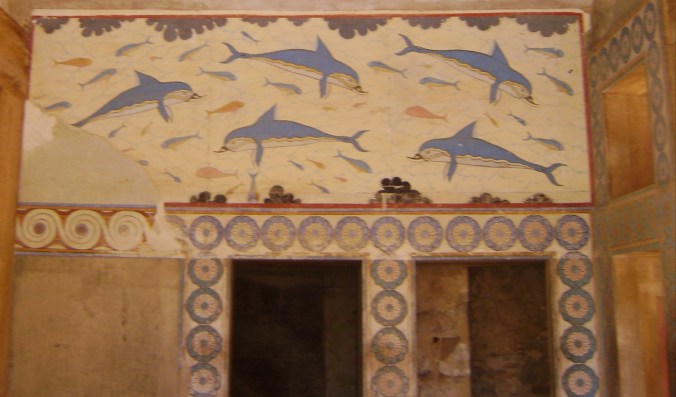
The Dolphin Fresco

Upon returning to grandma’s (γιαγιά) house,
and after being well-fed, of course,
a satisfying exhaustion takes over my body
and I fall into a deep sleep,
charging bulls, dolphins, and griffins infiltrating my dreams.
The Lily Priest-King and The Snake Goddess themselves
observe me from afar with knowing smiles but grave eyes
as it starts raining rosettes.
A sudden tidal wave hits the Palace,
and a chilling darkness overcomes me.
I wake in a cold sweat in the same blackness
and fear I haven’t awakened at all4

《Κόπηκε το ρεύμα,5》my γιαγιά blurts out.

***

I may have left, but the magic of Knossos
will never leave my heart and psyche,
even if I never set foot there ever again
6.


*More photos from my trip can be viewed here.
Please pardon the blurriness in some – these were all taken with a relatively cheap digital camera back in 2011…

Rosette divider
  1. ancient storage vessels ↩︎
  2. Gra Elia, while not at Knossos, is an ancient olive tree nearby that’s situated in the village of Vorizia, Heraklion. ↩︎
  3. a mountain located several kilometers away from Knossos that was a significant religious site for the Minoans ↩︎
  4. This actually happened! I sincerely thought I died. ↩︎
  5. “The power went out.” ↩︎
  6. I dream of being healed enough from generational trauma that I can return to my homeland someday. ↩︎