“Minoan Archaeology: Excavations at Gournia” by Sooteris Kyritsis

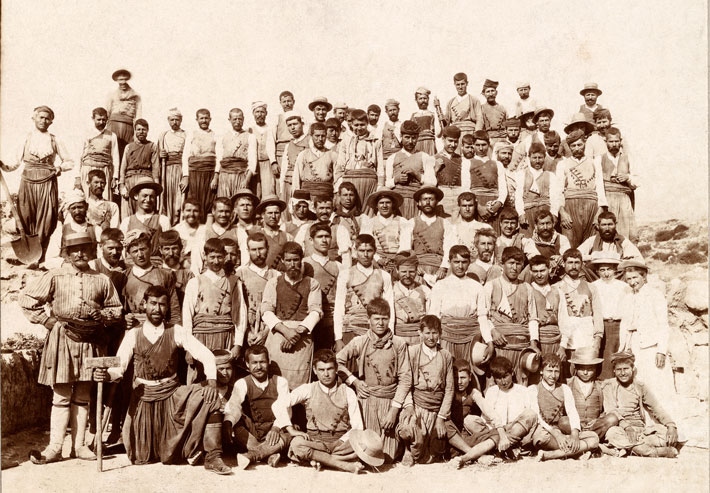
”I know a place where there are a lot of old things,” a peasant named George Perakis told the schoolmaster of the small village of Vasiliki, on the island of Crete, in the spring of 1901. Aware of a visiting American archaeologist’s anxious search to find a site of her own to excavate, the schoolmaster arranged for Perakis and his brother Nicholas to take Harriet Boyd and her colleague Blanche Wheeler to Gournia, four miles northwest of the village. Over several hours on May 19 Boyd collected a few potsherds and located the tops of several ancient walls, enough to convince her it was worth sending a team of workmen to the site the next morning. When she arrived at Gournia on the afternoon of the 20th, Boyd was astonished to see the men holding a bronze spear and sickle and numerous fragments of stone and pottery vessels, and clearing the threshold of a house and a well-paved road complete with a clay gutter. […]

Click here to continue reading!

Minoan Spring (a poem)

a researched poem about the vernal equinox in Ancient Crete

Warm westerly winds replace the biting gales of the north.
Crocus, poppy, and lily saplings slowly spring forth.
Rainy season makes its anticipated exodus as March wanes,
the sunshine igniting a mountainous scene amidst flowery plains.

The Mother Goddess’ blessings are ever-bountiful,
and so, her devotees honor her with a vibrant spring festival
brimming with offerings, worship, sacrifices, and ecstatic dance
to ensure another year of fertility, flourishment, and favorable circumstance.

In the sustained daylight and deep into the night,
they jubilantly celebrate the cyclical rhythms of life
and their spiritual ties to the natural world—
whether olive, boar or bee, existence ebbs and unfurls.

a close-up of the Spring Fresco from Akrokriti, depicting a rocky landscape with lilies and swallows

A Neophyte Bull-Leaper’s First Leap (a poem)

a mythological poetic story about a nervous yet brave novice bull-leaper (inspired by “The Bull-Leaping Fresco” and Martis, the main character of Eleanor Kuhn’s book “On the Horns of Death”)

an ivory figurine of a bull-leaper recovered from Knossos, 1600–1500 BCE

Body frozen in place by neophyte’s first-leap nerves.
Neither a blink nor a breath as she nears her turn.

First, it is her soul who leaps out of her chest and enters the ring
as a bull white as ivory charges towards her in full swing,
galloping hooves syncing with her quickening heartbeat.

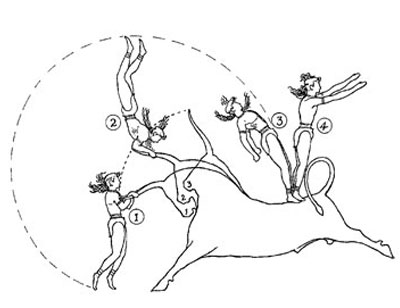
And so, she grabs the creature by the horns and flips,
ironclad her determination and grip,
then smooth as still sea, vaults over its back,
landing feet first assuredly upon the sand.

But as her turn arrives in real-time, she averts her eyes
and side-steps, barely veering from her demise.
Her fellow leapers try to pull her from the bull’s line of sight,
yet she remains a pillar unmoving; she must give it another try.

So, as the bull comes back around,
heaving as it tires from countless rounds,
she takes a deep breath and braces herself,
and as if divinely guided by The Goddess,
grasps the beast by the horns with calloused hands,
vaults, and lands, freezing in place upon his coarse back.
Her arms quiver in both excitement and fear
while her comrades gasp and cheer.

a line drawing by Sir Arthur Evans depicting the steps of bull-leaping