
The Fashion-Savvy People of Minoan Crete
Between the beautiful frescoes that adorned palace walls and unique statuettes, we can get a solid idea of Minoan women’s fashion sense. As with most fabrics, they’ve long disintegrated; however, some linen (potentially imported from Egypt) was found in a tomb from the Pre-Palatial Period at the site of Mochlos. Speaking of Egypt, considerable evidence of Minoan attire stemmed from their detailed depictions. For instance, at Thebes (Egypt’s capital during the 18th Dynasty), there were numerous frescoes found of “Aegean foreigners” from Keftiu (what Egyptians called Crete).

What Clothing Minoan Women (and Some Men) Wore
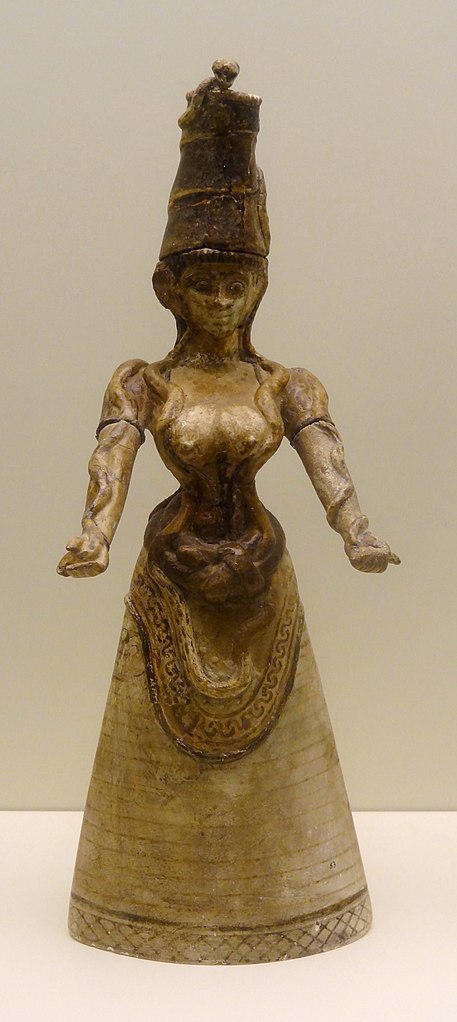
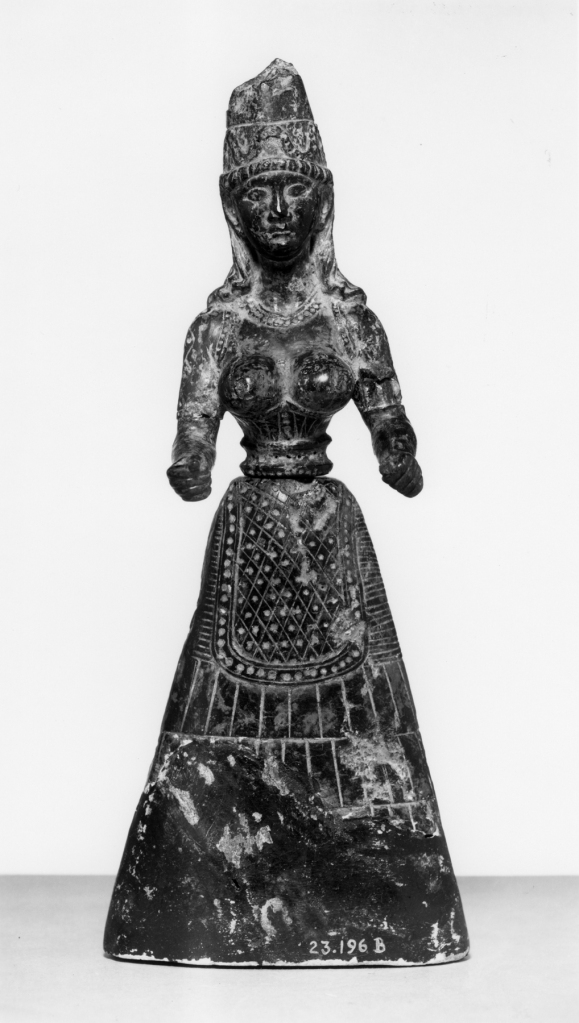
Three words come to mind when it comes to Minoan women’s attire: elaborate, vibrant, and multilayered. Long skirts with girdles encircling the waist and bare-breasted bodices were a staple. But due to that aforementioned multilayered nature, let’s break it down at bit:

Polychromatic, Decorative Skirts
Typically flounced (in later periods) and ankle-length, their skirts usually had pleats, ribbons, fringes—you name it. Other key features include: multi-layered, bell-shaped, and horizontal ruffles that sometimes widened on the way down. Alternatively, there were dresses with a v-shape, wrap-type style. Sheer veils were also sometimes incorporated.
Hand-Woven Open Bodices
Akin to “cardigans”, the sleeves were typically short or went halfway down the arms. Their often uncovered breasts signified fertility. On occasion, you’ll see tassels dangling from the sleeves in frescoes. Also on occasion, bodices curve into a high collar behind the nape of the neck.
Exquisitely Adorned, Waist-Slendering Belts
These belts remind me of the traditional Cretan costume I would wear during my Greek dance performances: wide, long, and intricately decorated. And they were tied super tight; I couldn’t wait to untie that thing after those performances.
Elegant Quilted Aprons
Worn over their long skirts on the front (or both sides), it is also similar to traditional Cretan attire. Much like the belts, the attention to detail on the aprons was evident.
Fancy Hats or Tiaras
Women in power or priestesses would wear high head-dresses, hats with various patterns, or even tiaras. Every day head pieces looked a bit like thick headbands that sometimes where tied at the top of the head.
Practical Undergarments
The low-rise bloomer (anasyrida) somewhat resembled a white sack with two holes in the bottom for each leg to go through. Over that, they wore flowing shorts that are basically “athletic shorts” formed by the double-apron joining the center of the backside apron with the center of the front side.
What Accessories & Cosmetics Minoan Women Wore
Just like their clothing, Minoan women’s jewelry was elaborate as well. The main materials used were gold, metal, precious stones, or even bone, and they were sometimes stitched on. Aesthetics were clearly of central focus in Minoan civilization and there was a lot to it, so let’s take a look at each aspect individually:


The Early “Grecian-style” Sandal
Minoan women wore fitted sandals with high straps (similar to what the later Ancient Greeks wore) and short boots. Within homes and sanctuaries, they were barefoot.
Fine Jewelry
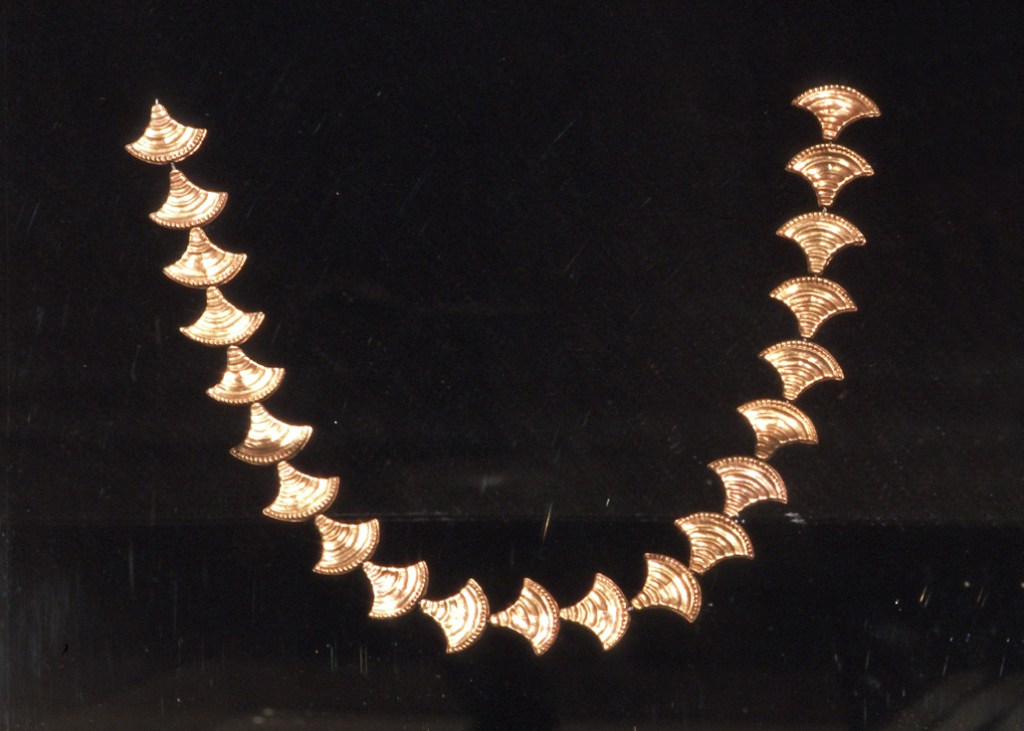
As mentioned, the Minoans crafted jewelry out of an array of high-quality, usually imported materials, including metal and precious stones (among them: gold, silver, carnelian, and amethyst). Spherical beads called psifoi were also made from faience (glazed ceramic). The kinds of jewelry seemed all-inclusive, from pendants, armbands, and necklaces, to bracelets and anklets.
Extravagant Hairstyles
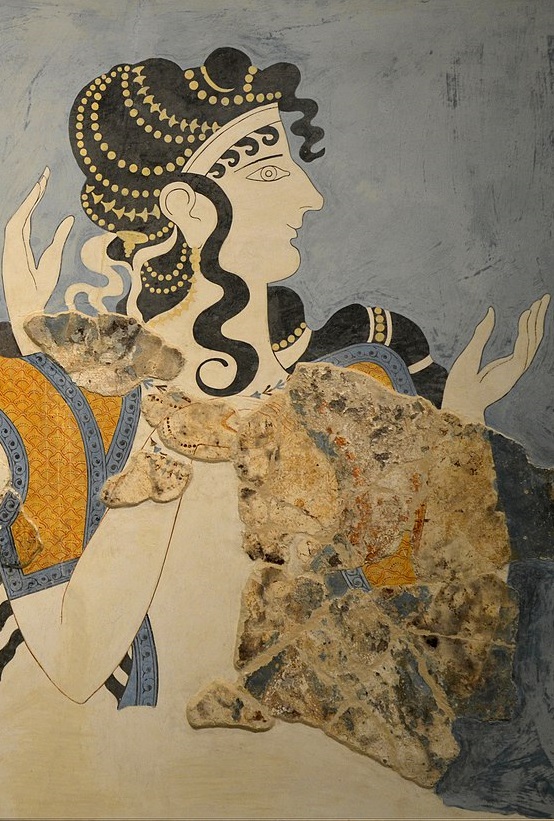
With emphasis on aesthetic beauty, it’s no surprise that Minoan women took great care of their face, body, and hair. One of their hairstyles featured a bun with small curls on the forehead and curled sideburns. For a more striking look, curled pieces of hair with secured/decorated with pins, beads, and floral-shaped clips. At times, they accentuated their look with bright ribbons, stylish nets, diadems (a bejeweled crown or headband), or hats.
Skincare
Many excavations point to olive oil being used topically to hydrate skin and give their tresses an unmatched sheen. This beauty “secret” is still used to this day.
Essential Oils and Perfume
Essential oils and perfume were extracted from plants like rose, nutmeg, anise, coriander, honey, and wine. Perfume-making workshops have been discovered at the several palaces, including Zakros, where excavators found amphorae with perfume residues as well as listings of aromatic plants.
Distinct Make-up
Their typical look was high-contrast, with a pale face (achieved by the application of white powder) as well as red lips, blushed cheeks, and red nails. The iconic feature of their make-up regimen was painting their eyelids with black paint, which was reminiscent of the Egyptian cat-eye.
*Click here to see my attempts at Minoan-inspired looks, mostly working with what I already had.
Sources
Encyclopedia: Fashion in the Minoan Period
Minoans: Peoples of the Past by J. Lesley Fitton
World History.Encycloedia: Beauty in the Bronze Age
Discover more from Minoan Magissa
Subscribe to get the latest posts sent to your email.
 Minoan Magissa
Pingback: Honoring My Cretan Ancestors with a Minoan-inspired Ritual | Minoan Magissa
WOW This is superb. You have certainly researched this extremely well. Thanks for sharing.
LikeLiked by 1 person
Thank you! I’m glad you think so. 😊
LikeLiked by 1 person
Reblogged this on Ritaroberts’s Blog and commented:
A well researched article for anyone interested in the Ancient Minoans.
LikeLiked by 1 person
These things are important in understanding who the Ancients and Ancestors were.
LikeLiked by 1 person
Indeed! Thanks for reading and commenting. 🙂
LikeLike
Pingback: 10 Devotional Acts for the Minoan Snake Goddess | Minoan Magissa
Pingback: Ancestral Connection and Healing through Dress: Minoan-Inspired Outfits by a Modern Day Cretan Person | Minoan Magissa
Pingback: The Minoan Goddess: A Modern Cretan Artist’s Rendition | Minoan Magissa
Pingback: Of Olive & Sea (My Cretan Ancestry) – a poem | Minoan Magissa
Elaborately decorated from head to toe except for the breasts. Interesting. Do you know why?
LikeLiked by 2 people
Indeed. It could be for a variety of reasons: a status symbol, to simply show off, or something as simple as mitigating the heat. In ancient times, it wasn’t seen as taboo to be topless. It was as natural for women as it was for men, and with Minoan society being more egalitarian with some matriarchal leanings, that makes sense.
LikeLiked by 2 people
Thank you for the explanation. It does make sense.
LikeLiked by 2 people
Pingback: Wearable Minoan Art: Dolphins & Rosettes | Minoan Magissa
Fantastically beautiful work, down to the detail! Thanks for helping this War State of a world to remember something so much better! Ancientlights.org
LikeLiked by 2 people
Thank you! It’s especially in times like these that we need to remember the beauty of humanity. So many, too many have lost touch with what makes us human due to a paradigm that’s bent on dehumanizing us.
LikeLiked by 2 people
I also see your fine piece about 2024 discoveries at the ritual center atop Papoura Hill in eastern Crete—I was there 2 months ago and explore its functions in this short essay: DISCOVERY IN CRETE CORROBORATES MINOAN ASTRONOMY & SOCIAL LIFE | jackdempseywriter
LikeLiked by 1 person
You are so RIGHT! Here are some detailed larger cosmic and current contexts via short talk (with musician Anna Stereopoulou) at Athens National Observatory: ANCIENT ASTRONOMY, MODERN SPIRIT-MUSIC—PART 2 of 3 | jackdempseywriter
LikeLiked by 1 person
PS—This is the most popular Minoan piece on my blog, hope you may enjoy! I live in Karteros, Crete now (9 years) and maybe someday we will meet! Many Smiles, Jack
COSMOS EROTICA: The Shapes of Minoan Desire | jackdempseywriter
LikeLiked by 1 person
This exquisite piece exudes elegance!
LikeLiked by 1 person
Thank you so much! 🙂
LikeLike
Pingback: How to Actually Dress Like a Minoan in the Modern Day | Minoan Magissa